No industry-standard formula tells you exactly what size jewelry armoire a large collection needs. Instead, count your rings, necklaces, earring pairs, and bracelets, then compare those totals to real capacity examples from actual armoire models — from compact units with around 33 hooks to high-capacity cabinets with over 100 ring slots — to see which range fits what you own.
Key takeaways
- There’s no universal sizing formula. No source maps “X pieces” to one correct armoire size; use real product examples as reference points instead.
- Count by type first. Rings, necklaces, earring pairs, and bracelets each need a different compartment type, so one combined “piece count” isn’t useful on its own.
- Compare to named examples, not a rule. Real armoires range from around 33 hooks and 75 earring slots on compact models up to 100+ ring slots on high-capacity standing cabinets.
- Watch for one overloaded category. A collection heavy in earrings or rings specifically needs a model strong in that one compartment type, not just a taller cabinet overall.
- If you outgrow even the biggest examples, plan on a second storage piece rather than hoping one armoire will stretch to fit everything.
Is there an industry-standard formula for armoire size vs. collection size?
No. Despite scattered capacity numbers across different retailers’ product pages, nothing in those listings or in any standards body adds up to a published formula like “a medium collection needs 50 hooks.” Treat any such rule you see elsewhere as a guess, not a verified standard. What does exist is real, specific data: individual named armoire models each list their own hook, slot, and drawer counts on their own product pages. Used correctly, that’s a set of real reference points, not a universal rule — and that distinction matters, because no two collections are organized the same way.
Step 1: Count what you actually own
Go through your current jewelry and sort it into four categories, counting each separately rather than lumping everything into one number:
- Rings — each needs its own ring slot or peg.
- Necklaces — each needs its own hook (see How to Stop Necklaces From Tangling in a Jewelry Armoire for why doubling up on hooks causes problems).
- Earring pairs — count pairs, not individual earrings, since most armoires list capacity in slots or holes per pair.
- Bracelets — count how many you’d want hanging on a rod at once, separate from bangles you might stack instead.
Step 2: Match each count to the compartment type it needs
Once you have four numbers, match them to the compartment types an armoire actually offers: necklace hooks, ring slots, earring slots or holes, and bracelet rods. A model can look spacious overall while still being short on exactly the compartment type your collection needs most — a cabinet with dozens of earring slots but only a handful of ring slots won’t solve a ring-heavy collection’s problem, even if it looks large.
Step 3: Compare your totals to real armoire examples
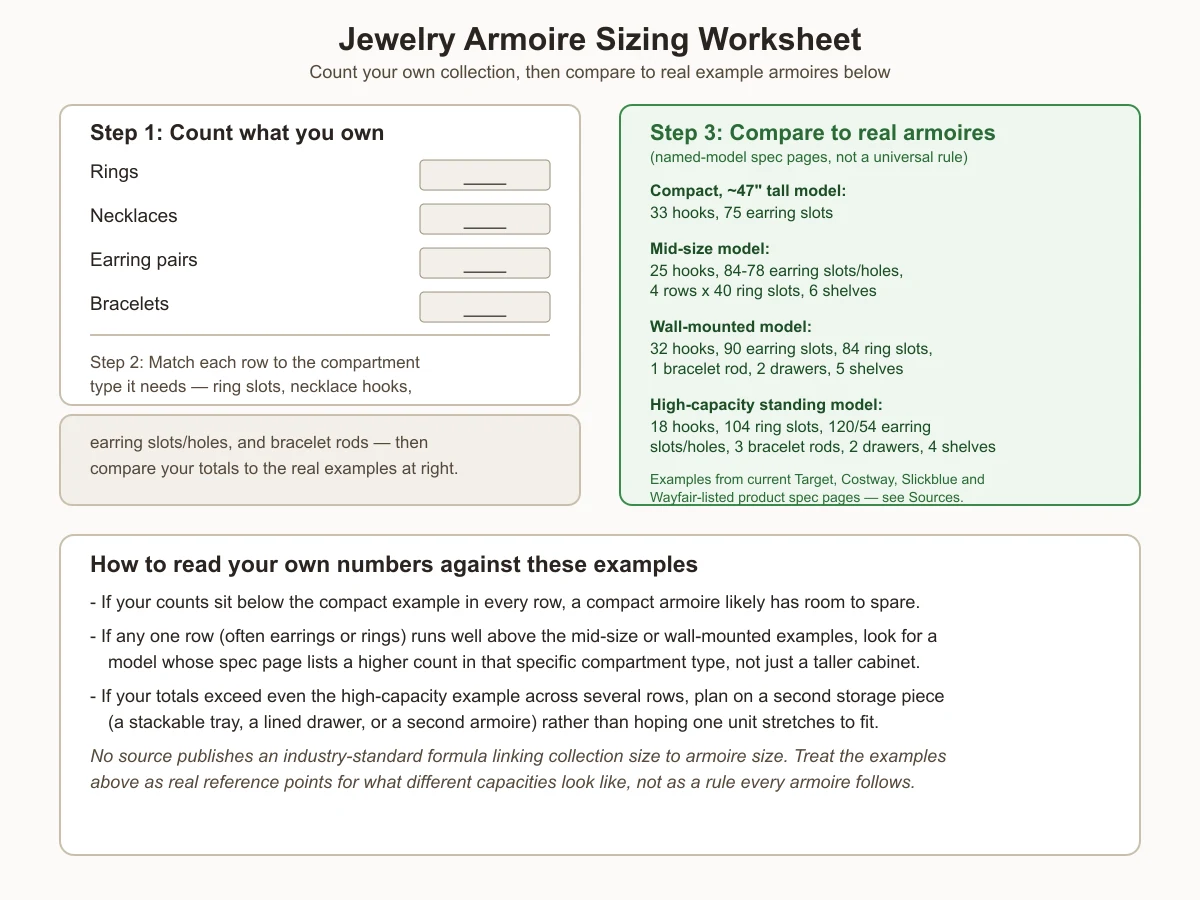
Here are four real, named models with their own published compartment counts, as illustrative examples of what different capacities actually look like — not as a formula to plug your numbers into:
| Example model | Necklace hooks | Ring slots | Earring slots/holes | Bracelet rods | Drawers/shelves |
|---|---|---|---|---|---|
| Wayfair-listed compact model (47.2″ tall) | 33 | not listed | 75 | not listed | not listed |
| Wayfair-listed larger model | 36 | 78 | 108 | 3 | not listed |
| Target Songmics standing cabinet | 18 | 104 | 120 slots / 54 holes | 3 | 2 drawers, 4 shelves |
| Costway wall/door-mounted cabinet | 25 | 4 rows of 40 | 84 slots / 78 holes | not listed | 6 lined shelves |
| Slickblue wall-mounted armoire | 32 | 84 | 90 slots / 48 holes | 1 | 2 drawers, 5 shelves |
Notice how capacity shifts by compartment type, not just by overall size: the Target Songmics model leads in ring slots but has fewer hooks than the Slickblue or Costway models. Match your own highest-count category to the example that’s strong in that specific compartment, not just the tallest or most expensive unit.
What if your collection is bigger than even the largest example here?
If your counts run above every example in the table across more than one category, a single armoire may not be the right tool anymore. Consider splitting your collection: keep daily-wear pieces in the armoire sized to fit them, and move rarely worn or seasonal pieces into a separate lined drawer, stackable tray, or a second storage piece. If you’re still deciding whether a box-style organizer could handle part of your collection instead, see Jewelry Armoire vs. Jewelry Box: What’s the Real Difference for a capacity-based comparison.
Thinking about building your own instead of buying one sized to fit?
If none of the ready-made capacity ranges above feel like a good match, converting a dresser you already own lets you build compartments sized to your own counts rather than someone else’s. See How to Convert an Old Dresser Into a Jewelry Armoire for the full process. For a wider look at sizing alongside lock type, mirror trade-offs, and lining material, our Jewelry Armoire Buying Guide covers all of these decisions together.
Frequently asked questions
Is there a jewelry armoire size chart based on collection size?
Not a verified one. No standards body or manufacturer publishes a formula linking a specific collection size to a specific armoire size. The most reliable approach is counting your own items by type and comparing those counts to real named models’ published compartment counts, like the examples in this article.
How many ring slots do I actually need?
Count your rings and compare that number directly to the ring-slot counts of real models, such as 104 on one standing cabinet or 84 on a wall-mounted model in the table above. If your ring count is close to or above those figures, prioritize a model that specifically lists a high ring-slot count, not just a tall or expensive unit overall.
What if my collection outgrows even the largest armoire I can find?
Split your storage rather than forcing everything into one piece. Keep the jewelry you wear most in the armoire, and move rarely worn or seasonal pieces into a separate lined drawer, stackable tray, or dedicated box.
Should I count jewelry I rarely wear when sizing an armoire?
Count it, but consider storing it separately. Including rarely worn pieces in your total count helps you size accurately, but routing them to a separate box or drawer instead of the armoire can free up your main unit’s best compartments for daily-wear pieces.
Should I size up to leave room for future jewelry purchases?
That’s a reasonable personal choice, but there’s no data to tell you by how much. If you tend to add a few pieces a year, choosing a model with some slots or hooks beyond your current count is sensible; just don’t size up so far that most of the armoire sits empty.
Sources
- Target, Songmics 360° swivel mirror jewelry cabinet product page — 120 earring slots/54 earring holes, 104 ring slots, 18 necklace hooks, 3 bracelet rods, 2 drawers, 4 shelves. Checked November 13, 2026.
- Wayfair, necklace/bracelet hook jewelry armoires category page — listed models with 108 earring slots/36 hooks/3 bracelet rods/78 ring slots, and a compact 33-hook/75-earring-slot model at 47.2 inches tall. Checked November 13, 2026.
- Costway, full-length mirror jewelry cabinet product page — 84 earring slots/78 earring holes across 6 lined shelves, 25 hooks, 4 rows of 40 ring slots. Checked November 13, 2026.
- Slickblue, rustic brown wall-mounted jewelry armoire product page — 90 earring slots, 48 stud holes, 32 necklace hooks, 84 ring slots, 1 bracelet rod, 5 shelves, 2 drawers. Checked November 13, 2026.
jewelryarmoireguide.com Editorial Team. Last updated: November 13, 2026.
Leave a Reply