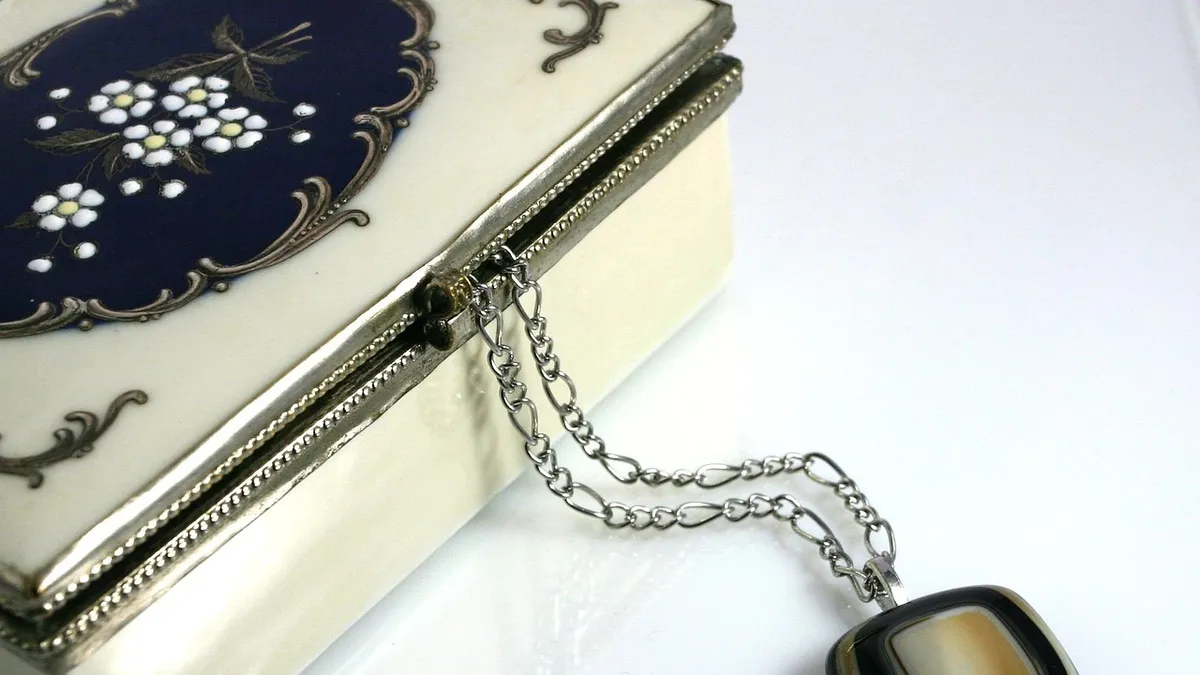
A jewelry box is a single small container, usually with one or a few trays, built for a modest collection; a jewelry armoire is larger furniture-scale storage with dedicated compartments — hooks, ring slots, drawers, shelves — built for a bigger or more varied collection. The real difference isn’t the name, it’s capacity and organization: a box holds what fits in one tray, an armoire is designed to separate many pieces by type.
Key takeaways
- A jewelry box is compact and portable; a jewelry armoire is furniture that stays in one place, mounted or freestanding.
- Capacity is the core difference, not the materials or the price. A box typically has one or a few trays; an armoire has many separate compartments.
- There’s no official piece-count threshold for “you need an armoire now” — watch for warning signs instead, like a drawer that won’t close or necklaces that constantly tangle.
- An armoire organizes by jewelry type (hooks for necklaces, slots for rings, rods for bracelets); a box usually mixes types in the same tray.
- Switching isn’t all-or-nothing — some people keep a small box for daily-wear pieces and an armoire for the rest.
What exactly separates a box from an armoire?
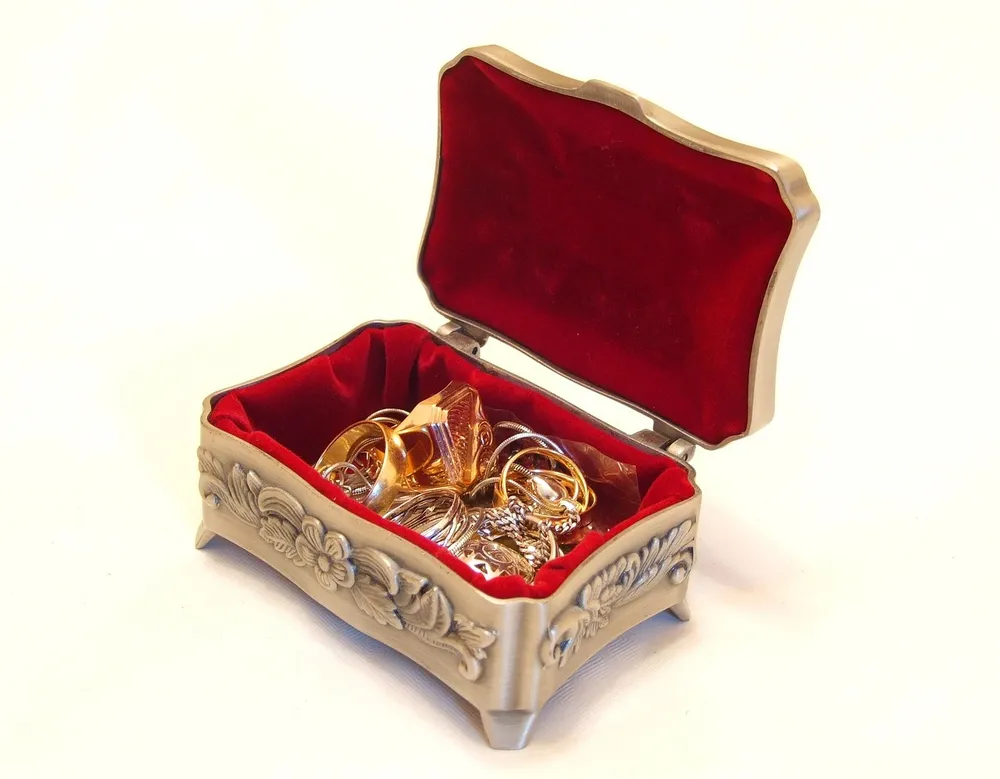
A jewelry box is a self-contained container — wood, metal, or fabric-covered — with one or a few lined compartments inside, often including a small mirror. It’s meant to sit on a dresser top or in a drawer and typically holds what fits in a single layer or two of trays.
A jewelry armoire is larger, furniture-scale storage: a standing cabinet or wall-mounted unit with multiple dedicated compartment types built in — necklace hooks, ring slots, earring slots or holes, bracelet rods, drawers, and shelves. Rather than one tray holding a mix of jewelry types, an armoire separates them by type across several compartments, which is the main practical reason it handles a bigger collection better. If you’ve already decided an armoire is the right move and want the full set of buying decisions — size, wall-mounted vs. freestanding, lock security, lining, and anchoring — see the Jewelry Armoire Buying Guide.
When is a box genuinely enough?
If your whole collection fits into one tray without stacking pieces on top of each other, and you can find any specific piece in a few seconds, a box is doing its job. There’s no official source that sets a specific piece-count number where a box stops being enough — it depends on piece size, how tightly packed your tray already is, and how many different jewelry types you own. Don’t trust any number you see online (“switch once you own more than X pieces”) as an industry standard; none exists.
Warning signs you’ve outgrown your box
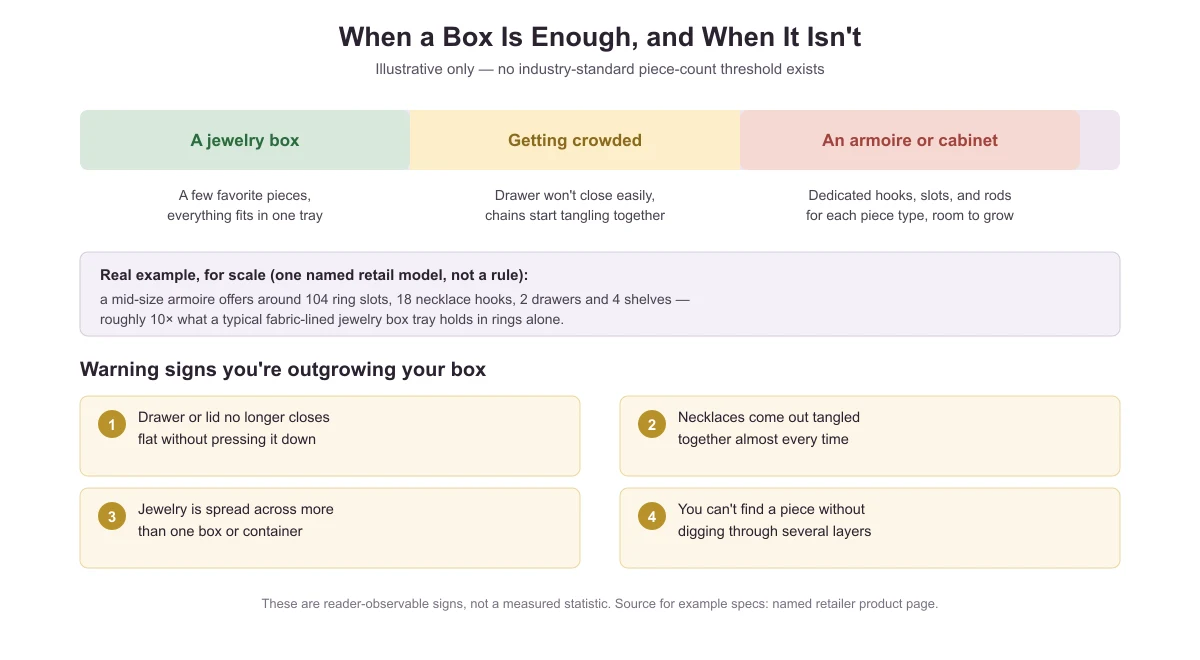
Instead of a number, watch for these reader-observable signs:
- The drawer or lid no longer closes flat without you pressing down on it.
- Necklaces come out tangled together almost every time you open it, because chains are touching in a crowded tray.
- Your jewelry is spread across more than one container — a sign the original box ran out of room and overflow went somewhere else, usually a drawer or a second small box.
- You can’t find a specific piece without digging through several layers, because everything is mixed together rather than separated by type.
What does an armoire actually add?
The main thing an armoire adds is separation by type, at a scale a box can’t match. One real example, for scale: a mid-size armoire on the market offers 104 ring slots, 18 necklace hooks, three bracelet rods, two drawers, and four shelves — a single named product’s spec, not a universal number, but illustrative of how much more an armoire format can hold compared with a typical box tray. That separation is also what the Gemological Institute of America’s own organizing guidance recommends: storing jewelry in containers with multiple compartments specifically to avoid tangling necklaces and scratching jewelry finishes or gemstones, which is exactly what an armoire’s many separate compartments are built to do. See How to Organize a Jewelry Armoire by Type for exactly how to match each jewelry type to the right compartment once you’ve made the switch.
Do you have to choose just one?
No. Plenty of people keep a small jewelry box for the handful of pieces they wear daily — quick to grab, easy to travel with — and a larger armoire for the rest of the collection, special-occasion pieces, or anything that needs more careful separation. If you go this route, treat the box as the “active” layer and the armoire as the main storage, rather than splitting your full collection evenly between both, which tends to recreate the same “can’t find it” problem in two places instead of one.
If you’re still unsure which size armoire makes sense once you’ve decided to switch, What Size Jewelry Armoire Do You Need for a Large Collection? walks through counting your collection and comparing it to real product examples.
What about cost and space?
A jewelry box costs less up front and takes up almost no space — it sits on a dresser top or fits in a drawer. A jewelry armoire is a bigger purchase and a bigger footprint, whether it’s a freestanding cabinet claiming floor space or a wall-mounted unit claiming wall space. That’s a fair trade for most people once a box genuinely isn’t working anymore, but it’s worth being honest about whether the problem is capacity or just a disorganized tray. Re-sorting an overcrowded box by type — rings in one spot, earrings in another, necklaces separated so they can’t tangle — sometimes buys more useful life out of a box you already own before you spend on an armoire.
If space is genuinely the constraint rather than money, remember that armoires come in both wall-mounted and freestanding styles, which return floor space or wall space back to the room depending on which one you pick. That choice depends on your walls, your lease, and your collection size, and is worth settling before you buy rather than after.
Frequently asked questions
Is an armoire always better than a box?
Not for every collection. If your jewelry comfortably fits a single tray and you’re not seeing the warning signs above, a box is simpler, more portable, and takes up less space. An armoire makes the most sense once separation and capacity become real problems.
How many pieces do I need before I should switch?
There’s no official number. Piece size, how tightly you pack a tray, and how many different jewelry types you own all matter more than a raw count. Use the warning signs in this article instead of looking for a specific threshold.
Can a jewelry box have a lock, like an armoire?
Some do, usually a small clasp or simple lock. Whether it’s on a box or an armoire, this kind of lock is generally a deterrent against casual access, not a security device for valuable pieces — see Are Jewelry Armoire Locks Actually Secure? for the full explanation.
Is a jewelry armoire worth it if I travel often?
An armoire stays in place, so it doesn’t help with travel directly. Many people keep a small travel case or box specifically for trips, separate from either a box or an armoire used for home storage.
Sources
- Songmics jewelry armoire product page, sold via Target — real-product sizing example (104 ring slots, 18 necklace hooks, three bracelet rods, two drawers, four shelves), used as an illustrative capacity example only, not a universal standard. Checked November 2026.
- Gemological Institute of America (GIA), “Five Tips to Organize Your Jewelry” — recommends multi-compartment storage to prevent tangling and scratching, supporting why an armoire’s separated compartments help a larger collection. Checked November 2026.
jewelryarmoireguide.com Editorial Team. Last updated: November 13, 2026.
Leave a Reply