
Last updated: November 16, 2026
Quick answer: a jewelry armoire vs jewelry box choice usually comes down to 2 things—capacity and portability. A jewelry armoire is better if you store a lot of pieces in one place on a dresser or vanity, while a jewelry box is better if you want portable, compact storage. I would choose the armoire for larger collections that need drawers, hanging space, and easy sorting; I would choose the box for smaller collections or for moving jewelry from room to room.
Key takeaways
- Pick a jewelry armoire when your collection needs vertical storage, more drawers, and a fixed home on a dresser or vanity.
- Pick a jewelry box when portability, small size, and simple access matter more than capacity.
- The armoire usually wins on organization, but it takes more space and stays put.
- The jewelry box usually wins on convenience, but it fills up faster and can turn into a jumble.
- If the piece must stay out of sight, a jewelry box hides more easily; if display and access matter, the armoire fits better.
A quick note on how this jewelry armoire vs jewelry box comparison is framed: this is a storage decision, not a style contest. A good choice depends on how many pieces you own, how often you wear them, and whether the storage will live on a dresser top or a vanity.
What is the real difference?

The real difference is that a jewelry armoire is furniture, while a jewelry box is container storage. An armoire usually stands on the floor or sits on a larger surface, with multiple drawers and often side compartments, so it works like a mini organizer for a whole collection.
A jewelry box is the smaller, portable option. It is meant for fewer pieces, quicker access, and easier moving. If the question is “Which one holds more and sorts better?” the armoire wins. If the question is “Which one is easier to carry, tuck away, or place on a dresser top?” the box wins. For a broader overview of storage layouts, see the jewelry armoire guide and the jewelry box guide.
| Criteria | Jewelry armoire | Jewelry box | Winner for [condition] |
|---|---|---|---|
| Capacity | Usually higher because of drawers and vertical storage | Usually lower because of a compact footprint | Armoire for larger collections |
| Drawer storage | Multiple drawers are common | Some boxes have trays or one main compartment | Armoire for sorting by type |
| Portable storage | Poorer portability; it is meant to stay put | Easy to move from room to room | Jewelry box for travel-like use |
| Desktop storage | Needs more space and can crowd a vanity | Fits on a dresser top more easily | Jewelry box for small surfaces |
| Display vs concealment | Better for display and organized access | Better for hiding a few pieces | Box for concealment |
| Speed of access | Good once organized, but more steps | Fast for simple grab-and-go storage | Box for a small daily set |
| Collection growth | Handles growth better | Can outgrow quickly | Armoire for expanding collections |
| Footprint | Larger, more visible presence | Smaller, easier to place | Box for tight spaces |
| Best setting | Vanity or bedroom with room to spare | Dresser top, shelf, or bedside area | Depends on available surface |
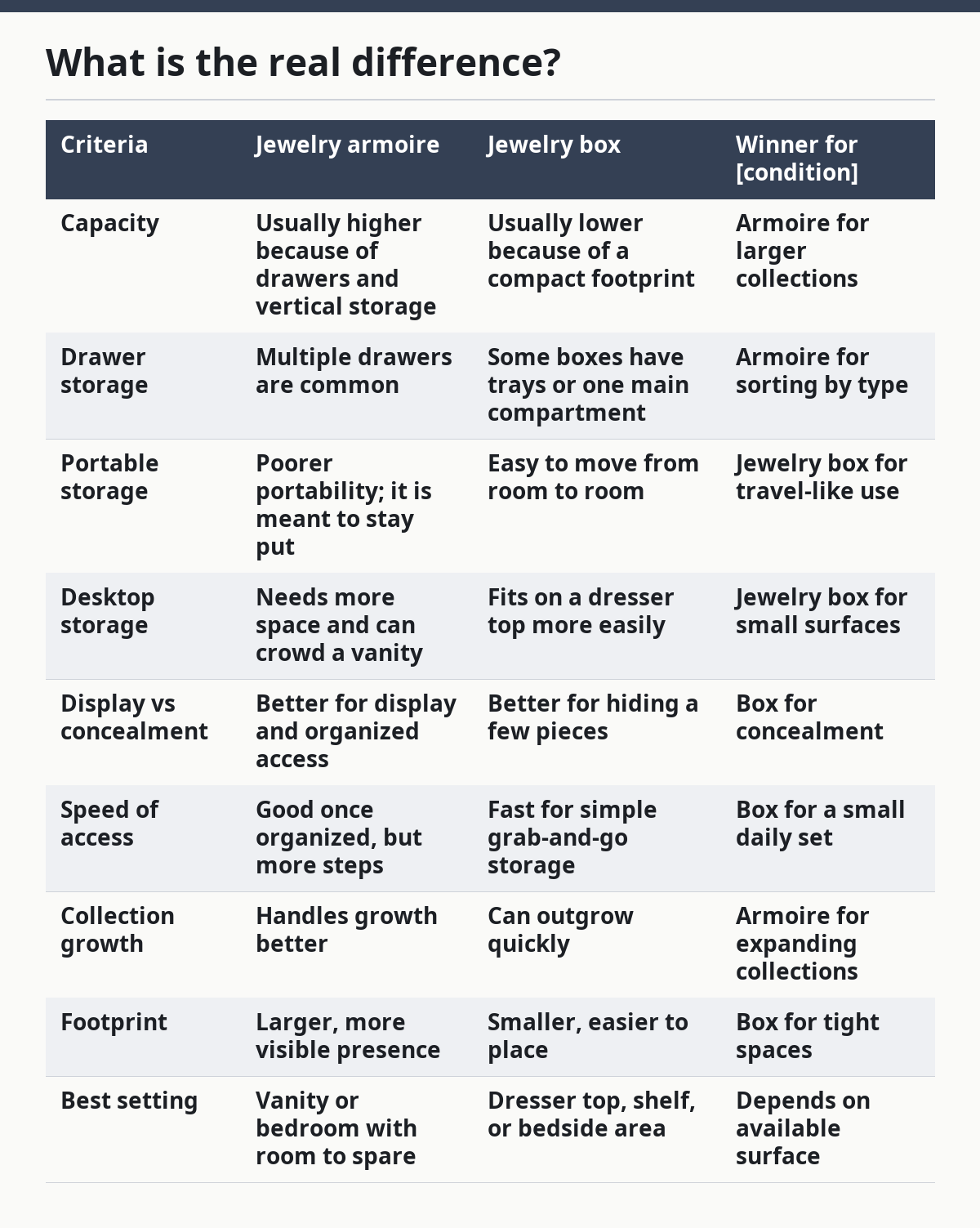
The armoire is the better long-term storage form for most people who own more than a few necklaces, bracelets, rings, and earrings. The box is the better everyday choice if the collection is modest and the goal is keeping essentials together.
What does a jewelry armoire do better?
A jewelry armoire does better when the problem is organization, not just storage. The reason is simple: drawers give each type of jewelry a separate home, which cuts down on tangles and mixed piles. That matters more when a collection includes long chains, several pairs of earrings, and pieces worn on different days.
The armoire also fits the way many people actually use jewelry. One drawer can hold rings, another can hold bracelets, and another can handle necklaces that need more room. That layout makes it easier to find a piece without digging through a single deep compartment.
The drawback is the same thing that makes it useful: size. An armoire takes up more visual and physical space, so it is a poor fit for a tiny room, a narrow vanity, or a dresser top already crowded with lamps, cosmetics, or a mirror. It also is not the right choice if you need to move jewelry often.
A jewelry armoire is not for someone who owns only a few daily pieces and wants them out of the way. It is for the person whose jewelry keeps expanding and who wants the storage to feel like part of the room, not a small accessory. For a broader overview of fit, storage style, and placement, the jewelry armoire guide is the better next stop.
What does a jewelry box do better?
A jewelry box does better when the goal is quick, compact storage. It is smaller, easier to place on a dresser top, and easier to pick up if the jewelry needs to move between rooms or travel in a bag. That makes it a strong match for a lighter collection or for daily pieces that are worn often.
A jewelry box also hides clutter well. If the main goal is to keep a few pieces together and out of sight, a box does that with less fuss than a larger piece of furniture. It can sit on a vanity without taking over the surface, which matters in a shared bedroom or a small apartment.
The weakness is limited room. Once the collection grows past a modest set, the box can become crowded fast, and crowded storage is where tangles, scratches, and lost pairs start to happen. A single compartment is fine for a few items; it is not fine for a collection that needs sorting by type. According to the American Gem Society, proper storage and careful handling help reduce jewelry damage from scratches and tangles, which is why tighter storage can become a problem as collections grow.
A jewelry box is not for someone with a deep, rotating collection or anyone who wants the storage to function like a small organizer cabinet. It is best for people who value portability, simple access, and a small footprint more than capacity.
Which one fits a dresser top or vanity?
A jewelry box fits a dresser top or vanity better when surface space is limited. It is easier to place beside a lamp, a tray, or skincare items without making the whole surface feel crowded.
A jewelry armoire fits a vanity better when the vanity itself is the jewelry station and there is enough room for a taller piece. In that setup, the armoire becomes part of the routine: open a drawer, choose a piece, close it, and move on. That works especially well when the jewelry is used daily and needs a clear home.
The trade-off is obvious. A box is less demanding and less visible, but it gives you less room to grow. An armoire gives you more room and more order, but it claims more of the room. If the surface is already busy, the box is the safer pick. If the surface can support a larger storage piece and the collection needs structure, the armoire is stronger. For space planning and room fit, the jewelry storage guide can help with the next decision.
This is also where display vs concealment matters most. A box hides better. An armoire organizes better. The right answer depends on whether the goal is to keep a few pieces tucked away or to make a collection easier to use every day.
Who should choose a jewelry armoire?
A jewelry armoire is the right choice for someone with a growing collection who wants everything in one place. It wins when the main problem is sorting, not just storing. The multiple drawers and larger structure make it easier to separate necklaces, rings, and earrings, which helps prevent the “one pile of jewelry” problem.
It also suits someone who keeps jewelry in one room and does not need to carry it around. A vanity or bedroom corner is the right setting because the armoire is part storage and part furniture. If the goal is to create a dedicated place for jewelry, the armoire is the more serious tool.
The downside is that it asks for commitment. It is not portable, it occupies more room, and it can look oversized in a small space. Someone who moves often, shares a tight room, or owns only a few daily items should skip it. A jewelry box will feel less bulky and more practical in those cases.
The armoire is the stronger recommendation for a person who wants organized capacity and can give it a permanent spot. It is a weaker choice for anyone who values easy moving or has no spare surface or floor space. For more examples of how size affects the decision, see the jewelry armoire guide.
Who should choose a jewelry box?
A jewelry box is the right choice for someone who wants compact storage for a smaller set of pieces. It wins when the daily routine is simple: a few rings, a favorite chain, a pair of earrings, and maybe one or two extras.
It also suits someone who changes storage locations often. A box can go from dresser top to drawer to suitcase without much effort. That makes it practical for dorm rooms, shared bedrooms, and small apartments where furniture space is tight.
The weakness is capacity. A box can feel full before a collection truly stops growing, and that can lead to mixed pieces and cramped storage. If the person already owns several necklaces or a large earring collection, the box can become a bottleneck instead of a solution. Consumer Reports also notes that cluttered storage tends to make items harder to find and easier to damage, which is part of the reason compact boxes work best for smaller sets.
A jewelry box is not for a collector who needs drawer storage and room to sort by category. It is the better answer for a lighter collection, a smaller room, or anyone who wants one neat place for a few essentials. For storage basics and buying considerations, the jewelry box guide is a useful next read.
When does the answer flip?
The answer flips in a few clear cases. If the jewelry collection is small but the room is tiny, the jewelry box wins because it fits without crowding the space. If the collection is large but the room has a proper vanity or dresser with room to spare, the jewelry armoire wins because it handles growth better.
If the jewelry must move often, the box wins even when the collection is not tiny. That is true for people who share space, rearrange rooms, or want the option to tuck jewelry away fast. The armoire loses in those cases because it is built to stay put.
If the top priority is keeping pieces hidden, the box is the safer call. If the top priority is sorting several types of jewelry without mixing them, the armoire is the better call. Those two needs pull in opposite directions, and that is why the answer is not one-size-fits-all.
I would also flip away from both if the jewelry is more valuable or more sensitive than either storage type can comfortably protect. This page is about storage style and access, not jewelry security. For that question, consult a jeweler or security professional about a more specialized secure case.
Which one should you buy?
Choose a jewelry armoire if you own enough pieces to need drawer storage, want a fixed home on a vanity or dresser, and care more about organization than portability. Choose a jewelry box if you want compact storage, a smaller footprint, and something you can move easily from place to place. Neither if your main need is locking up valuable jewelry or storing a collection that needs a specialized secure case; consult a professional for that use case.
If the choice comes down to one sentence, make it this: pick the armoire for a larger, stay-put collection; pick the box for a smaller, movable one. That is the cleanest way to match storage type to real use.
For readers who want to go deeper on the armoire side of the decision, the jewelry armoire guide covers the next layer: how the storage style fits the way a room is used.
Drafted with AI; not yet reviewed by a person.
Leave a Reply