Last updated: November 16, 2026
Quick Answer: for many homes, a jewelry armoire is worth owning if you want one closed cabinet to hold daily pieces, keep tangles down, and free up a dresser top; it is the wrong choice if your room is tiny, your collection is very small, or you need a wall-mounted solution. A good armoire works like a private landing zone for necklaces, rings, watches, and earrings, not like a display case that asks for constant fussing. This guide to Owning and Using a Jewelry Armoire: The Complete Guide focuses on how it works in real rooms, what it stores, and when a smaller organizer is the better buy.
Key takeaways:
- A jewelry armoire helps most when a collection needs both order and fast access.
- It is often a strong fit for people who want hidden storage, a mirror, and drawer-style sorting in one piece.
- It is a poor fit for very small rooms, renters who want wall storage, and anyone who only owns a few items.
- The biggest risks are tip-over, drawer clutter, and buying a model that looks large but stores poorly.
- A quick check of anchoring, door swing, and interior layout matters more than finish color.
What does a jewelry armoire actually do?
A jewelry armoire stores jewelry in a tall cabinet with drawers, hooks, trays, and often a mirror, so the collection stays together instead of spreading across a nightstand. It usually sits on the floor, which gives it more room than a shallow box and less visual clutter than open trays.
That simple job hides the real value: separation. Necklaces need hanging space, rings need small slots, earrings need pairs kept together, and watches need a place that does not scratch them. An armoire can handle all four in one place, which is why it makes sense for people whose jewelry has outgrown a tray or a small box.
The trade-off is size. A jewelry armoire takes up floor space and adds a tall object to the room, so it is not a “set it anywhere” piece. It also asks for some routine, because an overstuffed drawer turns into a knot factory fast.
For room planning, think in furniture terms, not accessory terms. A jewelry armoire is closer to a narrow dresser than to a vanity box, and it should generally be treated that way. If the room already feels crowded, it may help to consult a furniture professional or retailer about dimensions, traffic flow, and anchoring before buying. A jewelry armoire also works best when the room can absorb its height without making the space feel cramped.
For general furniture safety, the U.S. Consumer Product Safety Commission has a tip-over prevention page here: https://www.cpsc.gov/Safety-Education/Safety-Education-Centers/Consumer-Safety-Guide/Tip-Over-Prevention. The Furniture Today standard talk around clothing storage units also often points to anchoring as the baseline, not the bonus.
Who should own one?
A jewelry armoire is often a strong choice for someone who wears jewelry often and wants it sorted by type in a single cabinet. It fits the person who reaches for the same few pieces most days but still owns enough extras to need drawers, hooks, and compartments.
It also works well in bedrooms where a mirror is useful and open storage would gather dust. A mirrored door or top panel can replace a separate small mirror in the room, which makes the armoire pull double duty. That is useful in guest rooms, rental bedrooms, and primary bedrooms with limited wall space.
The armoire is wrong for a person who wants portability. If jewelry travels often, a smaller travel case or compact jewelry box is easier to carry. It is also not the best fit for someone with only a handful of items, because the piece can feel oversized and underused.
A simple rule helps: if the collection needs at least three storage types — hanging, flat, and compartmentalized — the armoire earns its floor space. If the collection fits in one small tray, the armoire is probably more cabinet than necessary.
It is also a better buy when dust, pets, or toddler hands are part of the room. Closed doors protect jewelry better than open dishes, and that matters more than style. A piece that closes can keep a room calmer, though it still needs regular sorting to stay useful.
Jewelry armoire or jewelry box?
A jewelry armoire wins when the collection is larger, mixed, or awkwardly shaped; a jewelry box wins when the collection is small, portable, or mostly flat. That is the cleanest split, and it is the one most buyers should use.
The armoire gives height and zones. Necklaces can hang, bracelets can rest apart, and rings can live in lined slots or trays. The box gives compactness. It keeps a few daily items close at hand and disappears into a drawer or suitcase more easily.
Here is the practical difference side by side.
| Criteria | Jewelry Armoire | Jewelry Box | Winner for [condition] |
|---|---|---|---|
| Floor space | Takes up floor space and needs a clear corner | Sits on a dresser or in a drawer | Jewelry box for tight rooms |
| Storage types | Often includes hooks, drawers, and trays | Usually has fewer compartments | Armoire for mixed collections |
| Necklace care | Better for hanging longer chains | More prone to tangling if crowded | Armoire for necklaces |
| Portability | Not easy to move often | Easy to carry or pack | Jewelry box for travel |
| Visibility | Can keep pieces hidden behind doors | Often opens flat for quick viewing | Jewelry box for daily grab-and-go use |
| Capacity | Better for a growing collection | Best for a small collection | Armoire for larger collections |
| Room impact | Acts like furniture | Acts like a personal accessory | Jewelry box for minimal rooms |
| Dust control | Better when closed | Varies by lid and design | Armoire for dusty rooms |
| Setup effort | Needs placement and possibly anchoring | No real setup | Jewelry box for immediate use |
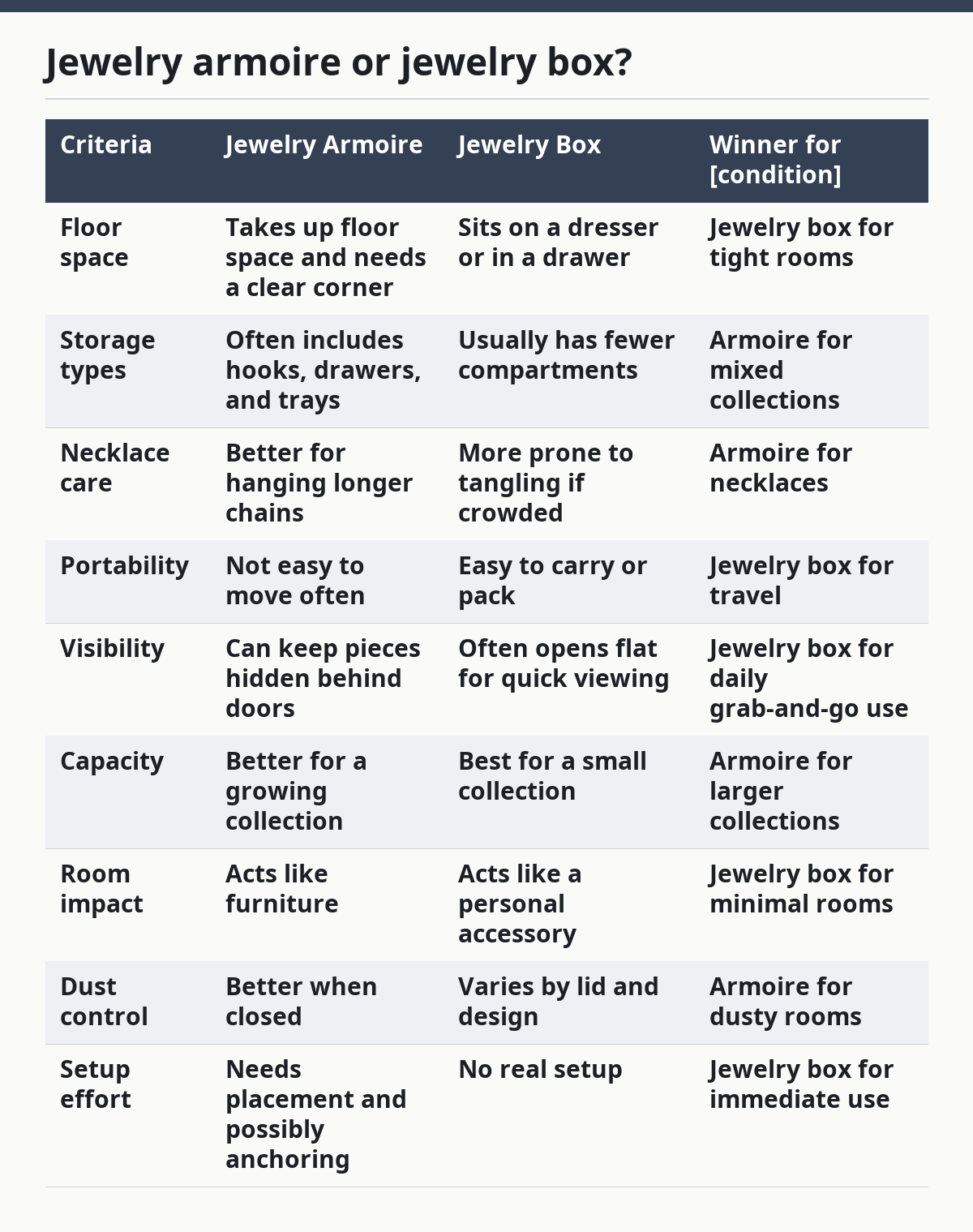
The armoire wins if the collection keeps growing, because it scales better without spreading into the rest of the room. The box wins if the goal is speed and simplicity. A lot of people want an armoire because it sounds more organized, but the real question is whether the collection needs a cabinet or just a better tray.
A generic article usually misses one thing here: jewelry boxes are not a “lesser” choice. They are the better choice when the collection is small enough to stay tidy in one place. Buying an armoire for five pieces of jewelry is like buying a filing cabinet for three receipts.
How should jewelry be arranged inside it?

Jewelry should be arranged by type and use, not by how it looks when first placed inside. Daily pieces belong in the easiest-to-reach spot, while special-occasion items can go in deeper drawers or lower trays.
Start with the pieces that tangle first. Necklaces should hang separately when possible, with clasps closed if the design allows it. Rings should stay in a dedicated slot or padded tray, because loose rings get lost in deep drawers fast. Earrings need pairs kept together, and watches should sit flat where metal and crystal will not rub against hard edges.
A practical system is to group by frequency. The top section can hold the two or three pieces used most often. Middle drawers can hold medium-use jewelry, and the lowest spaces can hold sentimental or seasonal items. That keeps the daily routine simple and reduces the chance of digging through everything just to find one chain.
Do not mix categories if the armoire gives separate spaces. A bracelet left in a necklace hook area can bent clasps and scratches happen, so the point of compartments is not just neatness; it is damage control.
A good habit is to leave some empty space. If every hook and slot is full, the storage system starts failing at once. Jewelry needs breathing room much more than most people expect, especially delicate chains and thin earrings.
Because of that, it helps to think like a conservator even in a home setting. The Smithsonian’s Museum Conservation Institute has public guidance on caring for metals and keeping them dry: https://www.si.edu/mci. The exact advice varies by material, but the core idea stays the same: moisture and mixed contact are the enemies. For owners who want to go deeper, that same habit also supports more careful jewelry storage and can reduce avoidable wear over time.
What should you check before buying one?
A jewelry armoire should be checked for layout, stability, and honest storage space before it is bought. Style comes after those three things.
The first check is the interior. Look at whether the hanging section is actually deep enough for the necklaces you own, whether the drawers are shallow enough to see into, and whether the ring slots are sized for the rings you wear. A pretty armoire with awkward compartments is just decorative clutter.
The second check is stability. A tall cabinet belongs against a wall, and anchoring matters even when the piece seems light. This is not a niche worry; it is part of basic furniture safety. The CPSC tip-over guidance exists because tall storage pieces can become hazards if they are pulled, bumped, or climbed on. For shoppers comparing furniture safety, this is one of the few checks that matters before finish, hardware, or style.
The third check is placement. Open the doors in your head before buying. A mirrored door may look useful, but it needs swing room. A drawer that opens into a bedframe or dresser corner will become annoying fast, even if the cabinet itself is well built.
The fourth check is finish and cleaning. Glossy surfaces show fingerprints. Dark wood shows dust. Light finishes can reveal scuffs from rings, zipper pulls, or bag clasps. None of that makes the armoire bad, but it does change how much care it needs.
A final check is whether the piece solves one problem or three. If it will hold jewelry, replace a mirror, and clear a dresser top, it is doing real work. If it only adds storage you do not need, skip it and keep the room simpler. If you are comparing dresser-top organization, the best armoire is the one that replaces clutter instead of adding to it.
What are the honest drawbacks?
A jewelry armoire can be awkward, space-hungry, and easy to overfill. That is the real cost of buying one, and it is worth saying plainly.
The first drawback is footprint. A tall cabinet can crowd a bedroom, especially if the room already has a bed, nightstand, and dresser. In a small room, the piece may dominate the wall more than the owner expects. If the floor plan is tight, the armoire can feel like one more thing to move around instead of a help.
The second drawback is temptation. Because the cabinet has drawers and hooks, it invites collection creep. People keep adding pieces because there is still one empty drawer, then the drawers lose their purpose. Once that happens, the armoire stops reducing clutter and starts hiding it.
The third drawback is access. A small box opens in one motion. An armoire often asks for a door, a drawer, and a choice about where each item belongs. That is great for sorting, but it is slower than dropping a ring into a tray at the end of the day.
The fourth drawback is that some designs look larger than they store. A wide frame, mirror panel, or decorative legs can reduce useful space inside. That is why dimensions alone are not enough; the layout matters just as much as the silhouette.
This is why the armoire is not for everyone. It is best for a person who values order enough to maintain it. If the answer is no, the cabinet becomes a pretty piece of furniture with a messy interior.
How do you keep one useful for years?
A jewelry armoire stays useful when it is treated like a system, not a dumping ground. The easiest way to do that is to reset it on a regular pattern, even if the pattern is simple.
Take out pieces that are not being worn. If a necklace has not been touched in a season, move it lower, store it separately, or remove it from the cabinet entirely if it no longer fits the collection.
Keep one category per space whenever possible. Rings in ring slots, earrings together, chains on hooks, watches flat. That habit makes the cabinet faster to use and easier to clean. Mixed piles are where tangles and scratches begin.
Clean the surfaces often enough to prevent residue from building up. A soft cloth is usually enough for the outside, but the real win is inside the drawers, where lint and dust collect quietly. The more pieces that touch a drawer lining, the more often the lining should be checked.
Protect the cabinet itself as well. If it is tall, place it where it cannot be bumped constantly. If it has a mirror, keep hard objects away from the front edge so the frame does not take repeated hits. Furniture lasts longer when it is not asked to absorb daily impact.
One useful rule is to revisit the layout every 3 months or so when the collection changes. New earrings, a repaired chain, or a watch that no longer fits can throw off the system. The armoire works best when the owner edits the contents instead of just closing the door.
When should you choose something else?
A different storage choice is better when the room, the collection, or the user makes the armoire feel oversized. That is the point where the honest answer is to skip it.
Choose a jewelry box instead if the collection is compact, travel matters, or the dresser already has a clean top. A box is lighter, easier to move, and less demanding. For many people, that is enough.
Choose wall storage if floor space is the real limit and the room can handle hooks or mounted pieces. That keeps the jewelry visible without taking a corner of the room. It also helps when a tall cabinet would block a window, a closet door, or a chair.
Choose open trays or a small organizer if the goal is daily convenience with almost no maintenance. That works well for a few pieces worn every day. It is not as protective, but it is faster.
Here are the exception scenarios where the overall armoire verdict flips:
- The collection is very small, even if the jewelry is expensive. A few pieces do not need cabinet storage.
- The bedroom is so tight that a tall floor piece would block movement. In that case, the armoire solves the wrong problem.
- The jewelry is mostly travel jewelry or pieces used outside the home. Portability matters more than capacity.
- The user wants display, not hiding. An open stand or tray fits that goal better than a closed cabinet.
That list matters because “more storage” is not the same as “better storage.” A jewelry armoire is a strong answer only when the room and the collection actually justify it.
Which one should you choose?
Choose a jewelry armoire if the collection is mixed, the room has floor space, and daily access matters more than portability. Choose a jewelry box if the collection is small, the room is tight, or the jewelry needs to move with you. Neither if the collection is so minor that a tray or drawer insert already solves the problem.
That is the cleanest verdict. The armoire is the better long-term home for a growing collection with necklaces, rings, earrings, and watches that each need a different kind of storage. The box is the better answer when simplicity wins.
The mistake most buyers make is treating the armoire as the default upgrade. It is not. It is a furniture decision, not just an organizer decision. If the cabinet will sit there for years and earn its keep, it is a smart buy. If it will become a tall catch-all, skip it.
What should a first-time owner remember?
A first-time owner should remember that the armoire is only as good as its layout and placement. Put the most-used pieces where they are easiest to reach, leave empty space, and keep the cabinet stable against the wall.
Do not try to make it hold everything at once. A jewelry armoire works best when it stays selective. When the drawers fill up, the right move is to edit the contents, not to keep forcing more into the same spaces.
Keep the door swing, drawer pull, and room traffic in mind. That matters as much as appearance. A cabinet that fits the room physically but interrupts daily movement will feel wrong every time it is used.
The final test is simple: if the armoire helps the owner put jewelry away in under a minute and find it again without digging, it is doing its job. If not, it is storage with a nicer finish, not a better system.
FAQ
Is a jewelry armoire better than a jewelry box?
A jewelry armoire is better when the collection is larger and needs different storage types in one place. A jewelry box is better when the collection is small, portable, or mostly daily-use pieces. The choice depends on whether the owner needs a cabinet or just a compact organizer.
Does a jewelry armoire need to be anchored?
A jewelry armoire should be anchored when the design or room setup makes tipping possible. Tall furniture belongs against a wall, and the CPSC tip-over guidance exists because that risk is real. If the piece is tall, light, or placed where children might pull on it, anchoring is the safer choice.
What should go in the top section?
The top section should hold the pieces used most often, such as daily necklaces, rings, or earrings. The exact layout depends on the cabinet, but the key idea is speed: the items reached every day should not be buried in a lower drawer. That keeps the system easy to maintain.
How often should I reorganize it?
A jewelry armoire should be reorganized whenever the collection changes enough to create clutter, which for many people means every few months. New pieces, repaired pieces, and items that stop getting worn can all throw off the original layout. A quick reset keeps the cabinet useful instead of crowded.
Is an armoire worth it for a small bedroom?
A jewelry armoire can be worth it in a small bedroom only if it replaces another piece of clutter and still leaves enough floor space to move comfortably. If it blocks a door, crowds the bed, or makes the room feel busy, a smaller organizer is the better call.
Drafted with AI; not yet reviewed by a person.
Leave a Reply