Anchor a wall-mounted jewelry armoire into a wall stud (or a proper masonry anchor on brick or concrete) using two metal or thick-plastic brackets and a heavy nylon or braided-steel strap, and check that the anchor kit’s weight rating covers the armoire’s fully loaded weight, not just the empty cabinet. This follows the Consumer Product Safety Commission’s Anchor It! guidance for furniture with drawers, doors, and shelves — drywall alone cannot hold a loaded wall-mounted piece safely.
- A stud finder is the only reliable way to locate a strong anchor point — don’t guess or rely on a drywall anchor alone.
- Use two anchor points spaced across the armoire’s width, not just one in the center.
- Check the anchor kit’s weight rating against the armoire’s real loaded weight — cabinet, drawers, liners, and jewelry combined.
- Tug-test the mount after installing it, and recheck periodically.
- This is sound general anchoring practice from CPSC, not a legal requirement specific to jewelry armoires — the federal mandatory standard that uses a 27-inch height threshold applies to clothing storage units like dressers, not this furniture category.
Why does a wall-mounted jewelry armoire need anchoring at all?
Any furniture piece with drawers, doors, or shelves can become unstable if it isn’t properly secured — the Consumer Product Safety Commission’s Anchor It! campaign states this guidance applies broadly to furniture with these features, not just dressers. A wall-mounted jewelry armoire is typically narrow and top-heavy relative to its depth, and opening a door or a drawer shifts its center of gravity outward, away from the wall. If the mounting hardware isn’t anchored into something solid, that shift in weight can pull the piece loose.
This matters most in homes with children who might climb, pull, or hang on furniture, but a poorly anchored wall-mounted piece is a real risk for any household — a full load of jewelry and liners adds real weight on top of the cabinet itself.
Does a federal safety rule legally require this?
Be precise about what does and doesn’t apply here. In 2023, the CPSC adopted ASTM F2057-23 as a mandatory federal safety standard (16 CFR Part 1261), effective September 1, 2023. It requires “clothing storage units” — dressers, chests, and similar furniture — that are 27 inches or taller to pass tip-over stability testing.
A wall-mounted jewelry armoire is not a clothing storage unit, so this specific mandatory rule does not legally apply to it. What does apply is CPSC’s broader, non-mandatory Anchor It! guidance, which recommends anchoring “all furniture with drawers, doors, and shelves” to the wall as sound safety practice. Treat the anchoring steps in this guide as good practice you’re choosing to follow, not a product-specific law you’re required to meet — the safety reasoning behind both is the same even though only one is a legal mandate.
What hardware do you actually need?
CPSC’s own “What You’ll Need” guidance for furniture anchoring lists specific hardware depending on your wall type:
| Wall type | Hardware needed |
|---|---|
| Drywall or plaster (most interior walls) | Anchor kit, stud finder, pencil, drill, drill bits, drywall screws, screwdriver |
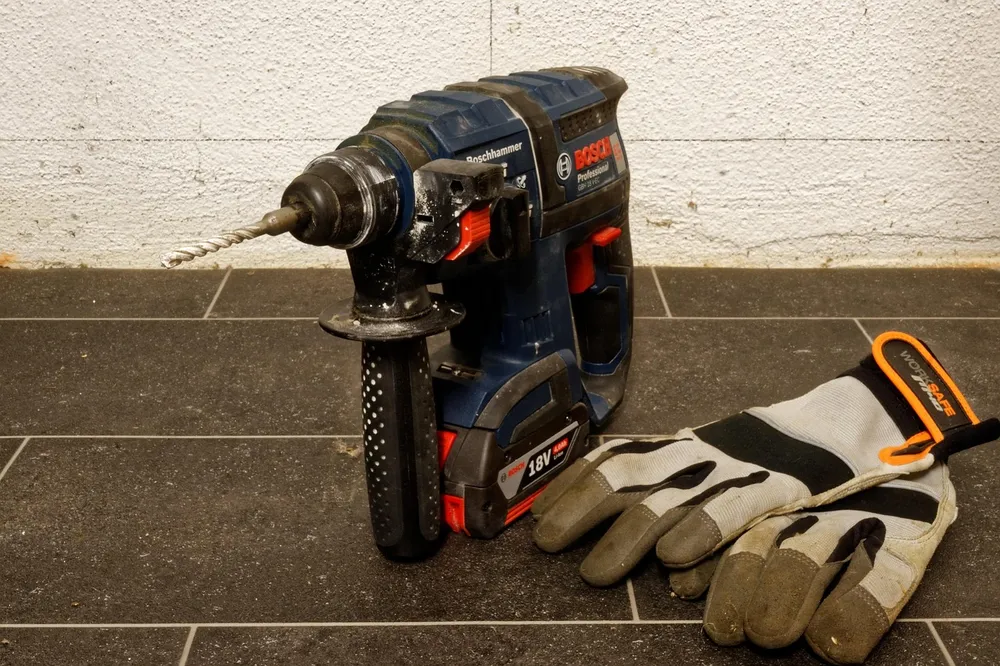
| Brick or masonry | Anchor kit, masonry bit, heavy-duty hammer drill, concrete screw anchors, impact driver |
In both cases, the anchor kit itself should include mounting brackets or plates and a connecting strap made of metal, thick plastic, heavy nylon, or braided steel — not a thin cord or a single small screw.
How do you find and use a stud for a narrow wall unit?
A stud finder is the only reliable way to locate solid framing behind drywall. In most U.S. homes, studs are spaced 16 inches on-center, with 24 inches used in some construction — so on a narrow jewelry armoire, you may only have one or two studs available across its width. Here’s the process:
- Run the stud finder across the wall at the height where the armoire will hang, marking both edges of each stud you find.
- Mark the center of each stud, and compare those positions to your armoire’s mounting bracket spacing.
- If the armoire’s brackets don’t line up with a stud, you may need to adjust the armoire’s position slightly, or use brackets designed to span between two studs.
- For masonry walls, skip the stud finder — you’re drilling into the brick or concrete itself with the correct masonry anchors instead.
Avoid the temptation to mount into drywall alone just because a stud doesn’t line up conveniently. A drywall-only anchor is not rated to hold a loaded wall furniture piece long-term.

Where should the two anchor points go on a narrow unit?
Because a wall-mounted jewelry armoire is typically narrower than a dresser, placing anchor points matters more, not less. Position one bracket near each side of the cabinet, as close to the outer edges as the armoire’s frame allows, rather than clustering both near the center. Two points spread across the width resist a side-to-side or forward tipping force far better than a single central anchor, and if one anchor point happens to miss solid framing, the other point still provides real support.
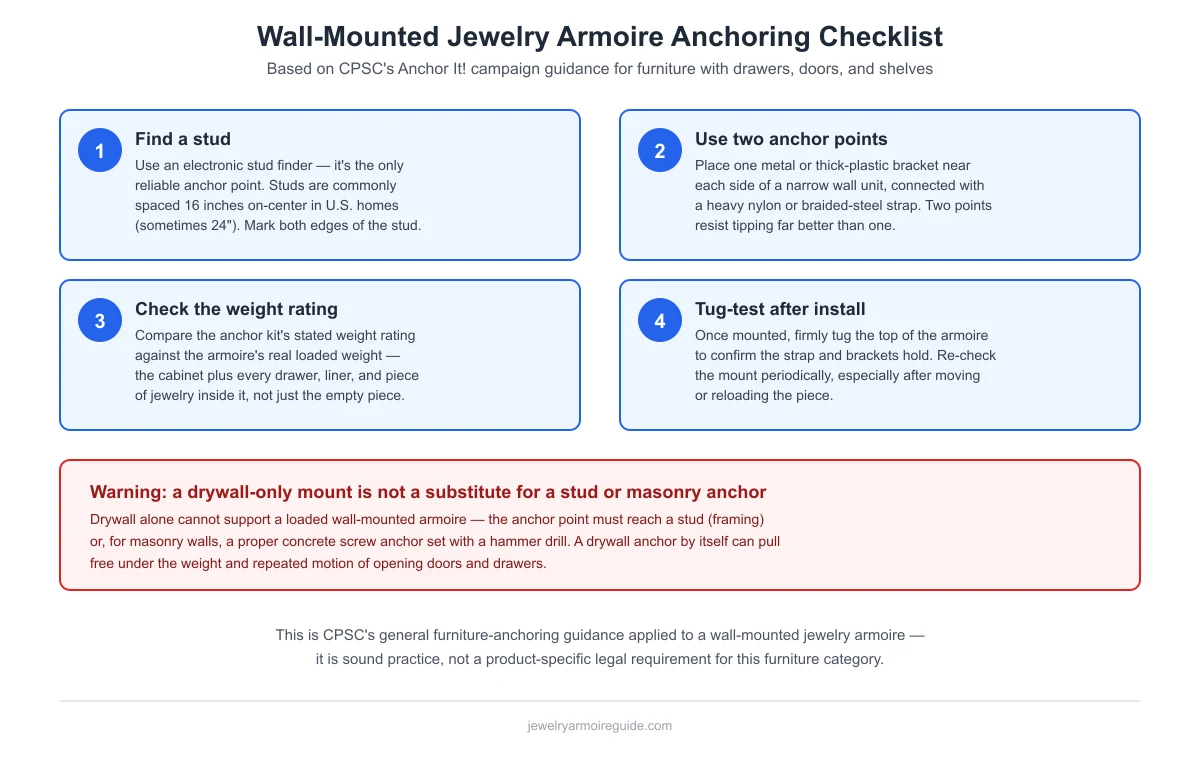
Use the full checklist below as a step-by-step reference while you work:
How do you know if the anchor can hold the armoire’s real weight?
CPSC’s anchoring guidance is direct on this point: check the anchor kit’s specifications to confirm it can hold more weight than your furniture piece. For a jewelry armoire, “your furniture piece” means more than the empty cabinet — it means the cabinet plus every drawer, every liner, and the jewelry stored inside once your collection is fully loaded. No source publishes a standard maximum safe weight for a loaded wall-mounted jewelry armoire, so don’t rely on a guessed number. Instead, check two things directly: the armoire manufacturer’s own mounting instructions, and the anchor kit’s stated weight rating — then confirm the kit’s rating comfortably exceeds your realistic loaded weight.
If you’re still deciding how large an armoire to buy and want a sense of how much a fully loaded cabinet might weigh and hold, the sizing guide for large collections walks through counting your pieces against real product examples.
What should you do after mounting it?
Once the brackets and strap are installed, firmly tug the top of the armoire to confirm it doesn’t shift or pull away from the wall. Open every door and drawer to check that the piece stays stable even with its heaviest elements extended, since an open drawer shifts weight outward. Recheck the mount periodically — especially after moving the piece, adding significant new jewelry weight, or if you notice any wobble over time.
For the broader decision between wall-mounted and freestanding styles, including floor type, renter restrictions, and stud access, see the wall-mounted vs. freestanding comparison guide.
Frequently asked questions
Can I mount a jewelry armoire using only drywall anchors?
No. CPSC’s anchoring guidance treats a stud (or a proper masonry anchor on brick/concrete) as the only reliable anchor point. A drywall anchor alone is not designed to carry the ongoing weight and movement of a loaded furniture piece.
Is a wall-mounted jewelry armoire covered by the mandatory dresser tip-over rule?
No. The mandatory federal standard (16 CFR Part 1261, based on ASTM F2057-23) applies specifically to clothing storage units like dressers and chests, not wall-mounted jewelry armoires or cabinets. CPSC’s general Anchor It! anchoring guidance still applies as recommended practice, just not as a legal requirement for this product category.
What if I can’t find a stud where I want to hang the armoire?
Shift the armoire’s position slightly to align with available studs, or use a bracket style designed to bridge between two studs. Avoid mounting into drywall alone as a workaround.
How many anchor points does a narrow wall unit need?
At least two, placed near each side of the cabinet rather than both near the center, so the mount resists tipping from either direction.
Does the anchor kit’s weight rating need to match the empty armoire or the loaded one?
The loaded one. Compare the kit’s stated weight rating to the armoire’s weight once it holds all its drawers, liners, and jewelry — not just the empty cabinet’s shipping weight.
Sources
- CPSC, Anchor It! campaign — read November 2026
- CPSC, Anchor It!, “What You’ll Need” — read November 2026
- CPSC Newsroom, “CPSC Adopts Final Consumer Product Safety Standard to Prevent Tip-overs of Dressers and Other Clothing Storage Units” — read November 2026
- Wikipedia, “Wall stud” (standard residential stud spacing) — read November 2026
jewelryarmoireguide.com Editorial Team. Last updated: November 13, 2026.
Leave a Reply