Necklaces tangle inside a jewelry armoire mainly because more than one chain shares a hook, or because several necklaces hang at the same length and swing into each other. The fix is mechanical, not magic: hang exactly one necklace per hook, skip a hook between heavy pendants, and vary hanging length row by row so loops never touch.
Key takeaways
- One hook, one necklace. Doubling up is the single biggest cause of tangles inside an armoire.
- Space out heavy pendants. Leave an empty hook between large clasps or pendants so they can’t swing into a neighbor.
- Vary length by row. Short necklaces in front, longer ones in back, so loops hang at different depths instead of crossing.
- Already a tangled mess? Strip every hook bare, untangle the whole pile at once on a flat surface, then rehang using the method below.
- Out of hooks? Add a few small cup hooks to open panel space instead of loading up the hooks you already have.
Why do necklaces tangle inside an armoire in the first place?
Chains tangle when they touch each other. A clasp, jump ring, or pendant from one necklace catches on the links of another, and the more the armoire door opens and closes, the more those touching chains shift and knot together. This is simple cause and effect, not a design flaw in any particular armoire: hang two or three necklaces on the same hook, or let two long necklaces swing at the same height, and contact between them is almost guaranteed.
Conservators who store metal objects professionally work from the same logic, just for a different reason. Museum storage guidance for silver recommends wrapping and storing individual metal pieces separately, specifically to avoid one piece’s surface affecting another in storage — a tarnish and contact concern, not a tangling one, but it reflects the same underlying principle: separated pieces don’t interfere with each other, touching pieces do.
Jewelry industry guidance makes the tangling point directly, rather than by analogy. The Gemological Institute of America (GIA) recommends hanging necklaces “from hooks so they do not amass into a knot” — the exact one-hook, one-necklace principle this guide is built on.
The one-necklace-per-hook method, step by step
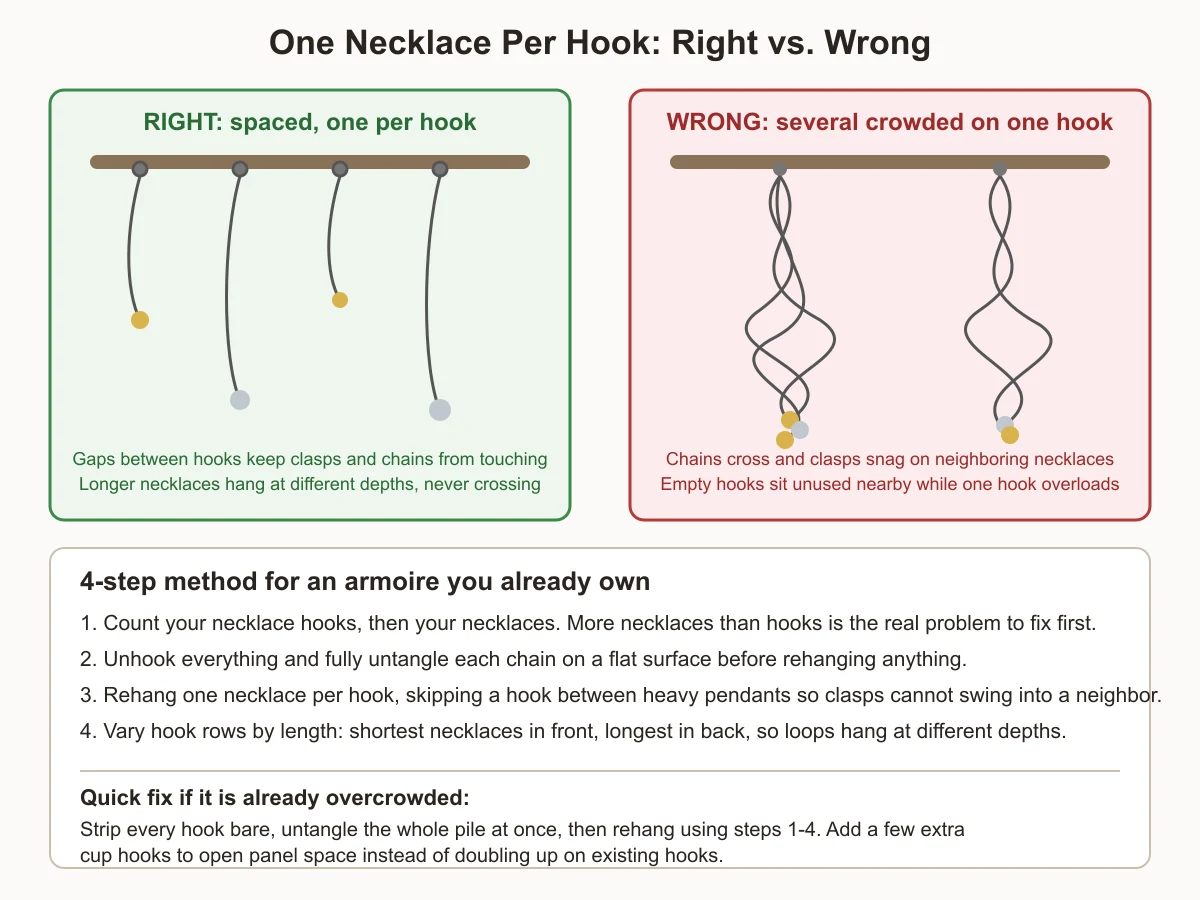
This works for any armoire you already own, whether it has 10 hooks or 40:
- Count your necklace hooks, then count your necklaces. If you own more necklaces than you have hooks, that mismatch — not your hanging technique — is the real problem to solve first. See What Size Jewelry Armoire Do You Need for a Large Collection? for how to match your counts to a bigger unit if you’ve outgrown this one.
- Take everything off every hook and fully untangle each chain on a flat, well-lit surface before you hang anything back. Rehanging a half-tangled chain just locks the knot in place.
- Hang one necklace per hook. No exceptions, even for short, light chains that “should” fit together.
- Skip a hook between heavy pendants or large clasps. A bare hook on either side of a bulky piece keeps it from swinging into its neighbors when the door opens.
- Vary hanging length by row. If your armoire has multiple hook rows, put your shortest necklaces on the front row and your longest on the back row, so the loops settle at different depths instead of crossing in the middle.
Right habits vs. wrong habits: a quick comparison
| Habit | What it does to your necklaces |
|---|---|
| One necklace per hook | Each chain hangs free with nothing touching it — no tangling |
| Two or three necklaces crammed on one hook | Clasps and links tangle together almost every time the door opens |
| Skipping a hook next to a heavy pendant | Prevents the pendant from swinging into the next necklace |
| All necklaces at the same hanging length | Loops swing at the same height and cross into each other |
| Short necklaces front, long necklaces back (by row) | Loops settle at different depths and rarely touch |
| Empty hooks unused while one hook is overloaded | Wastes available space and guarantees tangling on the crowded hook |
Quick fix for an armoire that’s already overcrowded
If you’re past the point of untangling one hook at a time, start over completely:
- Remove every necklace from every hook and lay them all out on a table or bed.
- Untangle the entire pile in one sitting rather than piece by piece back in the armoire, where cramped space makes knots harder to loosen.
- Rehang using the one-hook, one-necklace method above, working from your shortest necklace to your longest.
- If you run out of hooks before you run out of necklaces, add a few small adhesive or cup hooks to any open panel space inside the armoire rather than doubling up again.
For the full rundown on which compartment type suits each kind of jewelry — not just necklaces — see How to Organize a Jewelry Armoire by Type: Rings, Necklaces, Earrings, Bracelets.
Does the lining inside the armoire affect tangling too?
A soft-lined hook panel reduces metal-on-metal contact at the point where each chain hangs, which can help reduce scratching between pieces, separately from the tangling fix above. A lining choice does not solve tangling by itself — spacing and one-per-hook hanging do that — but if you also want a lining that does more than cushion, one that actually works against tarnish on silver pieces, see Anti-Tarnish Lining Materials for Jewelry Armoires, Explained for which fabrics are genuinely chemically active and which are decorative only.
Picking the right armoire if hooks keep running out
Sometimes the real issue isn’t technique, it’s that the armoire itself has too few hooks for the collection it’s holding. If you find yourself adding extra hooks every few months, it may be time to compare your actual counts against a bigger unit. Our full Jewelry Armoire Buying Guide: How to Choose the Right One walks through sizing, lock reality, mirror trade-offs, and lining material together as one decision, with links out to each topic in depth.
Frequently asked questions
Why do my necklaces always end up in a knot, even when I close the armoire gently?
Even gentle door movement shifts hanging chains slightly, and if two necklaces share a hook or hang at the same length, that small shift is enough for a clasp or link to catch on a neighboring chain. The fix is separation, not gentler handling: one hook per necklace, with varied hanging lengths row by row.
Can I hang two short, light necklaces on one hook if they’re delicate?
It’s better not to. Even light chains tangle when they touch, and delicate chains are often harder to untangle without stretching or kinking a link. If hook space is tight, add a small extra hook nearby rather than doubling up on an existing one.
What’s the fastest way to fix a drawer or panel full of already-tangled chains?
Take everything off at once and untangle the full pile on a flat, well-lit surface rather than one hook at a time inside the cramped armoire. Working in open space makes knots much easier to loosen, and you can rehang everything correctly in one pass instead of repeating the problem hook by hook.
Do necklace hooks need to be a special shape or material to prevent tangling?
No specific hook material is required for this fix to work — the spacing and one-per-hook method applies whether the hooks are metal, wood, or a soft-coated finish. A rounded hook with no sharp edges is gentler on delicate chains, but the tangling fix itself comes from spacing and technique, not the hook’s material.
Should heavier necklaces be stored differently from lightweight chains?
Give heavier necklaces and large pendants extra room: an empty hook on either side keeps their weight and swing from reaching a neighboring chain. Lightweight chains can sit closer together row to row, but each one should still get its own hook.
Sources
- Gemological Institute of America (GIA), “Five Tips to Organize Your Jewelry” — recommends hanging necklaces from hooks specifically so they don’t knot together, the direct basis for the one-hook, one-necklace method in this guide. Checked November 13, 2026.
- Wikipedia, Conservation and restoration of silver objects — general conservation practice of storing individual metal pieces separately rather than in contact with each other (cited here as a supporting analogy for separation, not as tangling-specific guidance). Checked November 13, 2026.
jewelryarmoireguide.com Editorial Team. Last updated: November 13, 2026.
Leave a Reply