A jewelry armoire‘s built-in lock is a deterrent, not a security device: it keeps out casual snooping but it is not designed, tested, or certified to resist prying, picking, or forced entry. The industry standard that covers cabinet locks (ANSI/BHMA A156.11) grades strength, durability, and finish — it does not test pick resistance. For genuinely valuable pieces, jewelry insurer Jewelers Mutual recommends a bolted-down safe or a bank safe-deposit box instead of relying on furniture storage alone.
- Most jewelry armoire locks are simple cam locks — a common, low-cost cabinet mechanism, not a security certification.
- ANSI/BHMA A156.11 is a real standard for cabinet locks, with Grade 1-3 tiers, but those grades test strength, durability, and finish, not pick resistance.
- A locked armoire mainly stops someone from casually opening a drawer and glancing inside — it is not built to stop a determined attempt to force or pick it.
- Jewelers Mutual’s own storage guidance points toward a bolted safe or a bank safe-deposit box for valuable or rarely-worn pieces, not a lockable cabinet.
- Pair the armoire’s lock with a real safe for your highest-value pieces, and reserve the armoire for jewelry you wear often.
What does an armoire lock actually do?
Most jewelry armoires use a cam lock: a cylinder that turns a flat metal arm (the “cam”) to catch behind a cabinet frame or drawer front. It’s the same basic mechanism used on mailboxes, file cabinets, and low-cost furniture. A cam lock is a mechanism type, not a security rating — nothing about using one means an armoire has been tested against forced entry or picking.
That doesn’t mean the lock is worthless. It stops a child, a houseguest, or anyone casually passing by from opening the armoire and seeing what’s inside. For many households, that’s the entire point: privacy and casual-access control, not theft prevention against someone who specifically wants in.
Is there a real standard for cabinet locks — and what does it actually cover?
Yes. ANSI/BHMA A156.11 is a genuine industry standard for cabinet locks, published by the Builders Hardware Manufacturers Association and accredited by ANSI. It defines Grade 1, 2, and 3 performance tiers for cabinet hardware, including locks.
Here’s the nuance that matters for a jewelry armoire buyer: those grades test security (resistance to force, such as sledgehammer blows or attempts to pull the lock out), durability (how the lock holds up over repeated use and temperature changes), and finish (resistance to scratches and corrosion) — not resistance to picking, bumping, or other non-destructive bypass techniques. A lock can pass a strength and cycle-life grade and still be easy for someone with basic tools and know-how to pick open, because picking resistance simply isn’t part of what that grade measures.
No manufacturer-level testing was found showing that cam locks used on jewelry armoires have been tested against any ANSI/BHMA grade at all, and none should be assumed to meet one without the maker stating so. The honest summary: a real standard for cabinet locks exists, it is not nothing, but it does not tell you anything about how pick-resistant a specific lock is.
What does it take to get past a typical armoire lock?
Cam locks and similar low-cost cabinet locks are widely known in the locksmith trade as straightforward to bypass with simple tools or techniques — picking, shimming, or in many cases just prying the thin cabinet door or drawer front itself, since the wood or MDF around the lock is often weaker than the lock. This guide won’t state a specific pick time, because no source has measured that figure for jewelry armoire locks specifically, and a made-up number would be exactly the kind of invented claim to avoid. The accurate statement is simpler: don’t expect the lock, or the cabinet around it, to resist a determined attempt to get in.
What does a real safe add that an armoire lock doesn’t?
A home safe that is bolted to the floor or wall framing changes the picture in two ways an armoire lock can’t: it resists being carried off entirely (which a lightweight armoire cannot), and a quality safe is independently rated for resistance to prying and sometimes fire. Jewelers Mutual’s jewelry-storage guidance specifically recommends a safe — bolted down, not just sitting in a closet — over dresser drawers or decorative furniture storage for protecting valuable pieces from theft.
For pieces you rarely wear — heirlooms, a second engagement ring, inherited sets — Jewelers Mutual’s guidance also points to a bank safe-deposit box as an option worth considering, since it adds a level of physical security and oversight that no piece of furniture in your home can match.
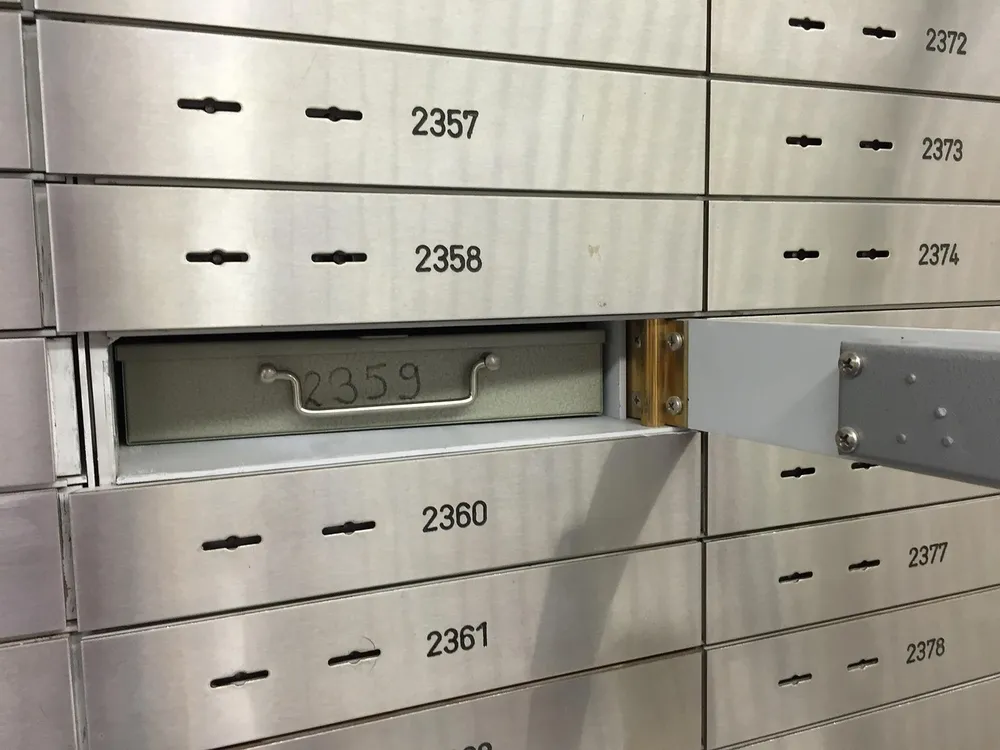
How do the storage tiers actually compare?
This chart lines up four common storage options against four real threats, based on what ANSI/BHMA A156.11 actually tests and Jewelers Mutual’s published storage guidance:
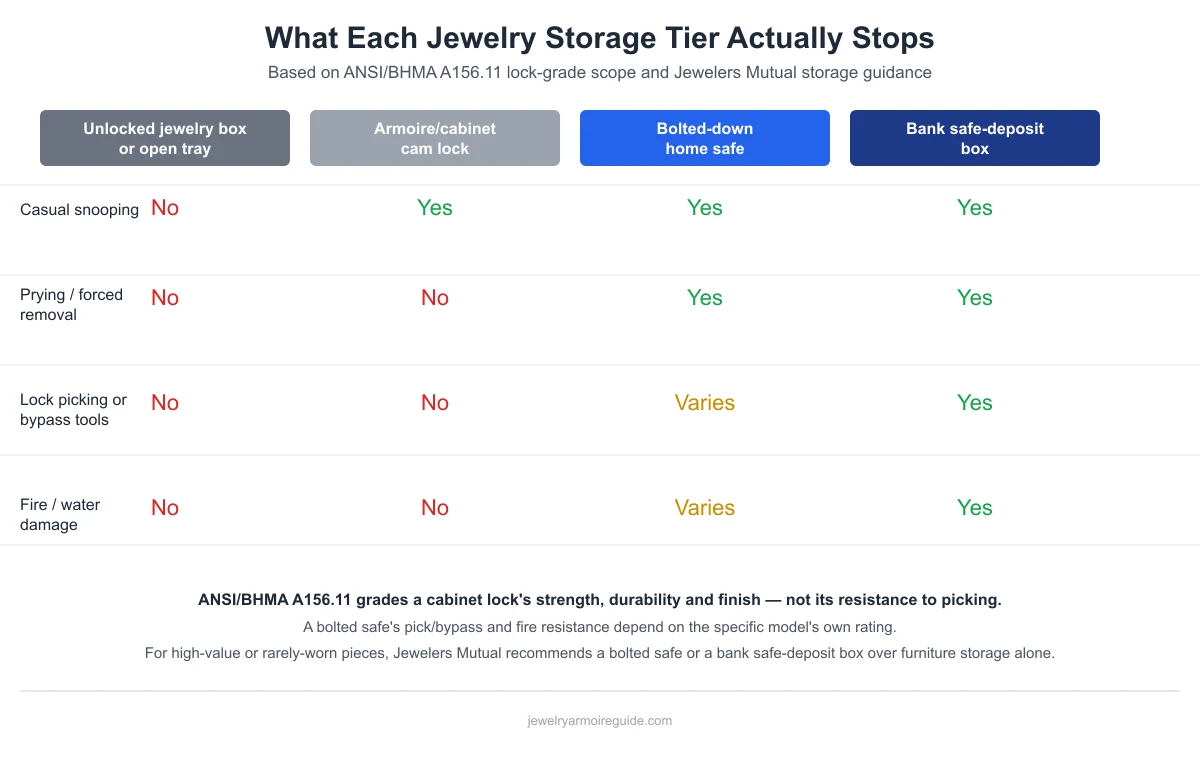
| Storage type | Stops casual snooping | Resists prying/forced removal | Resists picking/bypass tools | Fire/water resistant |
|---|---|---|---|---|
| Opened jewelry box or open tray | No | No | No | No |
| Armoire/cabinet cam lock | Yes | No | No | No |
| Bolted-down home safe | Yes | Yes | Varies by model | Varies by model |
| Bank safe-deposit box | Yes | Yes | Yes | Yes |
So what should you actually do?
Use the armoire’s lock for what it’s good at: keeping your everyday jewelry organized, private, and out of sight from casual visitors or curious kids. Don’t ask it to do a safe’s job. A practical split:
- Jewelry you wear regularly and could reasonably replace: fine to keep in a locked armoire.
- Engagement rings, heirlooms, or anything with high sentimental or financial value: move it to a bolted-down safe, or a bank safe-deposit box if you rarely wear it.
- If you’re still deciding how large an armoire you need once you’ve separated out your everyday pieces, the sizing guide for large collections can help you count what’s actually going inside it.
- For the rest of the buying decision — size, wall-mount vs. freestanding, mirror, materials — the jewelry armoire buying guide covers every factor together.
Frequently asked questions
Can a locked jewelry armoire be picked open?
Most armoire locks are simple cam locks, a mechanism type known in the locksmith trade to be straightforward to bypass with basic tools or techniques. No source measures an exact time for this, so treat “can be picked” as a real possibility rather than a remote one, and don’t store high-value pieces based on the lock alone.
Does a higher lock grade mean better security?
Not necessarily in the way people assume. ANSI/BHMA A156.11 grades measure strength, durability, and finish. A higher grade means the lock resists more force and lasts longer under repeated use — it says nothing about resistance to picking or bypass techniques.
Is it worth replacing a broken or missing armoire key?
If the lock still functions for its actual purpose — keeping the cabinet closed to casual view — a replacement key or a locksmith-cut key is a reasonable, low-cost fix. Just don’t treat getting the lock working again as a security upgrade; it restores privacy, not theft resistance.
Should I avoid lockable armoires since the lock isn’t very secure?
No — a lock is still useful for privacy and keeping curious hands out, and it costs you nothing extra to have one. The mistake is treating that lock as equivalent to a safe for your most valuable pieces.
What’s the single best upgrade if I only do one thing?
Move your highest-value pieces — engagement rings, heirlooms, anything hard to replace — into a bolted-down safe or a bank safe-deposit box. That one change addresses the actual gap between what an armoire lock does and what real security requires.
Sources
- ANSI/BHMA A156.11-2024, Cabinet Locks (ANSI/BHMA standard listing) — read November 2026
- Acme Locksmith, “BHMA Lock Rating” (locksmith trade explainer of what BHMA grades test) — read November 2026
- Jewelers Mutual, “How to store jewelry” — read November 2026
- Jewelers Mutual, “6 tips to keeping jewelry safe at home” — read November 2026
jewelryarmoireguide.com Editorial Team. Last updated: November 13, 2026.
Leave a Reply