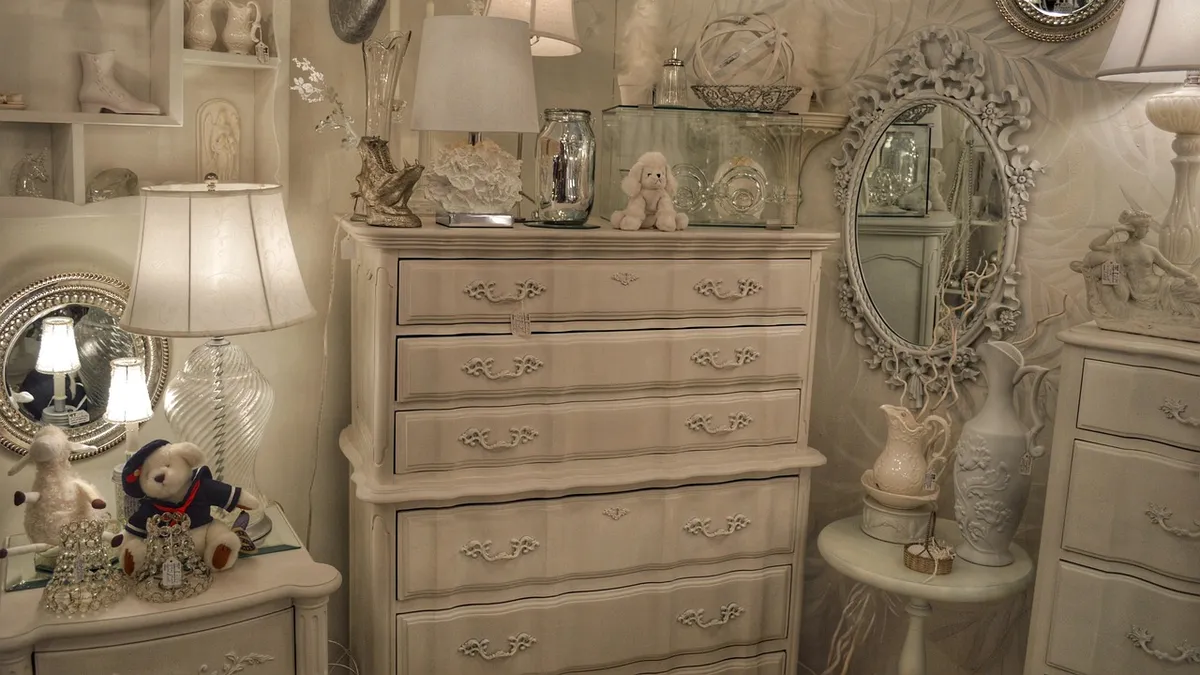
A wall-mounted jewelry armoire fits a room with a reachable wall stud and, for renters, a landlord’s okay to drill; a freestanding armoire fits a room with floor space and no drilling allowed. Floor type, stud access, renter status, and your collection size all point toward one or the other — rarely both.
Key takeaways
- Wall-mounted units must be anchored to a stud, not just drywall, before they’re loaded with jewelry.
- Renters without drilling permission should default to freestanding — it needs no wall modification at all.
- U.S. studs are typically spaced 16 inches on-center (sometimes 24 inches), which affects where a wall-mounted unit can actually go.
- Freestanding armoires need a stable, non-tipping base, especially on thick carpet or padding.
- Neither option is safe to skip the weight check on — confirm hardware or base stability against the piece’s fully loaded weight.
What’s actually different between the two?
A wall-mounted jewelry armoire hangs from the wall, usually via a bracket or French cleat system, and is anchored into a stud. A freestanding armoire stands on its own legs or base on the floor, like a small dresser or cabinet. Both styles use the same interior compartment types — hooks, ring slots, bracelet rods — the difference is entirely about how the unit is supported and where it can go in a room.
The U.S. Consumer Product Safety Commission’s Anchor It! campaign notes that anchoring guidance applies broadly to “furniture with drawers, doors, and shelves” — which covers both wall-mounted and freestanding armoires, just in different ways. A wall-mounted piece needs active anchoring hardware; a freestanding piece needs a stable footprint and, in some cases, its own anti-tip strap to the wall if it’s tall and top-heavy. This mounting choice is just one of several buying decisions — see the Jewelry Armoire Buying Guide for the complete checklist, including sizing, lock security, and lining material.
The decision table
Walk through each row. Whichever column gets more checkmarks for your situation is your likely fit.
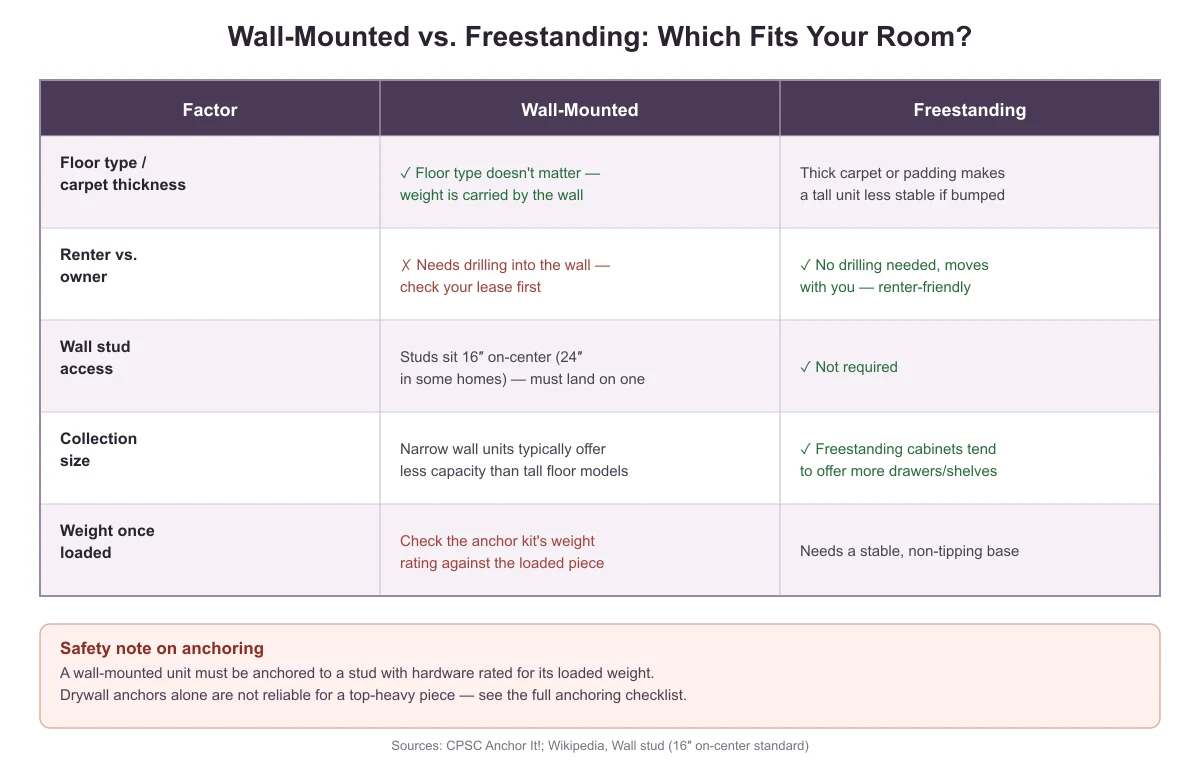
| Factor | Wall-Mounted | Freestanding |
|---|---|---|
| Floor type / carpet thickness | Doesn’t matter — weight is carried by the wall | Thick carpet or padding makes a tall unit less stable if bumped |
| Renter vs. owner | Needs drilling into the wall — check your lease first | No drilling needed, moves with you |
| Wall stud access | Must land on a stud (16″ on-center typically) | Not required |
| Collection size | Narrow wall units typically offer less capacity | Floor cabinets tend to offer more drawers and shelves |
| Weight once loaded | Check the anchor kit’s weight rating against the loaded piece | Needs a stable, non-tipping base |
If you’re renting
A rental agreement that prohibits drilling into walls effectively decides this question for you: freestanding is the only realistic option unless your landlord approves anchoring hardware in writing. Some wall-mounted armoires use removable French-cleat brackets that leave smaller holes than a full lag-bolt install, but “smaller holes” is not the same as “no holes” — confirm what your lease actually allows before you buy.

Finding a stud before you commit
U.S. residential construction typically frames wall studs 16 inches on-center, with 24-inch spacing used in some newer construction. That spacing determines where a wall-mounted armoire can realistically go — you can’t anchor it wherever looks nicest if there’s no stud behind that spot. Use a stud finder to confirm a stud’s exact location before you finalize where the armoire will hang, not after you’ve already picked a wall.
The U.S. Consumer Product Safety Commission’s hardware guidance for anchoring furniture specifies a stud finder, a drill, and either metal or thick-plastic brackets with a nylon or braided-steel strap for drywall/plaster walls, or a masonry bit and concrete screw anchors for brick walls. For the complete jewelry-armoire-specific anchoring checklist — including the two-point strap placement a narrow wall unit needs — see How to Anchor a Wall-Mounted Jewelry Armoire Safely.

Freestanding stability basics
A freestanding armoire doesn’t need a stud, but it does need a stable base. Thick carpet or plush padding under the feet makes a tall, top-heavy unit less stable and more prone to tipping if it’s bumped or a child pulls on an open door. No source gives a specific carpet-thickness threshold where this becomes a problem — it’s a general stability principle, not a measured number. If your freestanding armoire is tall and narrow, consider an anti-tip strap to the wall even though it isn’t drilled in as its primary support.
Does collection size change the answer?
Sometimes. Narrow wall-mounted units are often designed to save floor space, which usually means less overall capacity — fewer drawers, a thinner mirror panel, fewer total hooks and slots — than a taller freestanding cabinet built around a full footprint. If you have a large collection and limited wall space for a wide unit, a freestanding cabinet is often the more realistic fit. See What Size Jewelry Armoire Do You Need for a Large Collection? for real product examples at different capacities.
Room layout matters too, separately from wall space. A freestanding armoire needs a few square feet of clear floor it will occupy permanently, which can be a real constraint in a small bedroom already tight on walking space. A wall-mounted unit gives that floor space back, at the cost of needing a clear, reachable wall section — not blocked by a door swing, window, or existing furniture. Walk your actual room with a tape measure before deciding; a unit that looks fine in a showroom photo can still crowd a narrow bedroom.
Can you combine both approaches?
Yes, and it’s a reasonable solution if you have a genuinely large collection or jewelry that falls into different categories. Some households use a small wall-mounted unit near a mirror or vanity for everyday pieces, paired with a larger freestanding cabinet elsewhere in the bedroom for the rest of the collection or for pieces worn less often. This avoids overloading a single small wall-mounted unit while still keeping frequently worn jewelry within easy reach. If you take this route, each piece still needs its own anchoring or stability check — adding a second unit does not reduce the safety requirements for either one.
Frequently asked questions
Can I mount a jewelry armoire without finding a stud?
Not safely for a loaded unit. Drywall alone, without hitting a stud, cannot reliably support a cabinet loaded with jewelry and its own hardware weight over time. Use a stud finder and anchor into the stud, or switch to a freestanding model.
Is a freestanding armoire automatically safer than a wall-mounted one?
Not automatically. A tall, narrow freestanding unit on an unstable base can still tip if bumped. Anchoring risk doesn’t disappear with freestanding furniture, it just shifts from wall hardware to base stability and, for very top-heavy pieces, an anti-tip strap.
What if I rent and there’s no stud near where I want to mount it?
Go freestanding. Forcing a wall-mounted unit onto a spot without a stud, using drywall anchors alone, is not a safe substitute for proper stud anchoring once the piece is loaded.
Do wall-mounted jewelry armoires come in large sizes?
Some do, but most wall-mounted designs trade some capacity for a smaller footprint. If you need maximum capacity, check the specific model’s slot and hook counts rather than assuming “wall-mounted” means “compact.”
Sources
- U.S. Consumer Product Safety Commission, Anchor It! campaign, and “What You’ll Need” — anchoring applies to furniture with drawers, doors, and shelves; hardware differs for drywall vs. masonry walls. Checked November 2026.
- Wikipedia, Wall stud — 16-inch on-center standard U.S. residential framing spacing, 24-inch also used.
jewelryarmoireguide.com Editorial Team. Last updated: November 13, 2026.
Leave a Reply