Organize a jewelry armoire by matching each jewelry type to its own compartment: rings in padded ring slots, necklaces on individual spaced-out hooks, earrings in slots or holes, and bracelets on a horizontal rod. Mixing types in one open tray is what causes tangled chains, scratched rings, and lost earring backs — separating by compartment type fixes all three at once.
Key takeaways
- Each jewelry type has a compartment built for it on most armoires — hooks, ring slots, earring slots/holes, and bracelet rods are real, standard terms used on actual products.
- One necklace per hook, with spacing between hooks, is the single biggest fix for chain tangling.
- Rings belong in padded slots, not loose in a tray, to avoid scratching against bare wood or metal.
- If your armoire is missing a compartment type, there are simple workarounds rather than needing a different armoire entirely.
- Organizing by type also makes your collection easier to maintain — you can see at a glance what you have and what’s missing a spot.
Why organize by type instead of by how it looks?
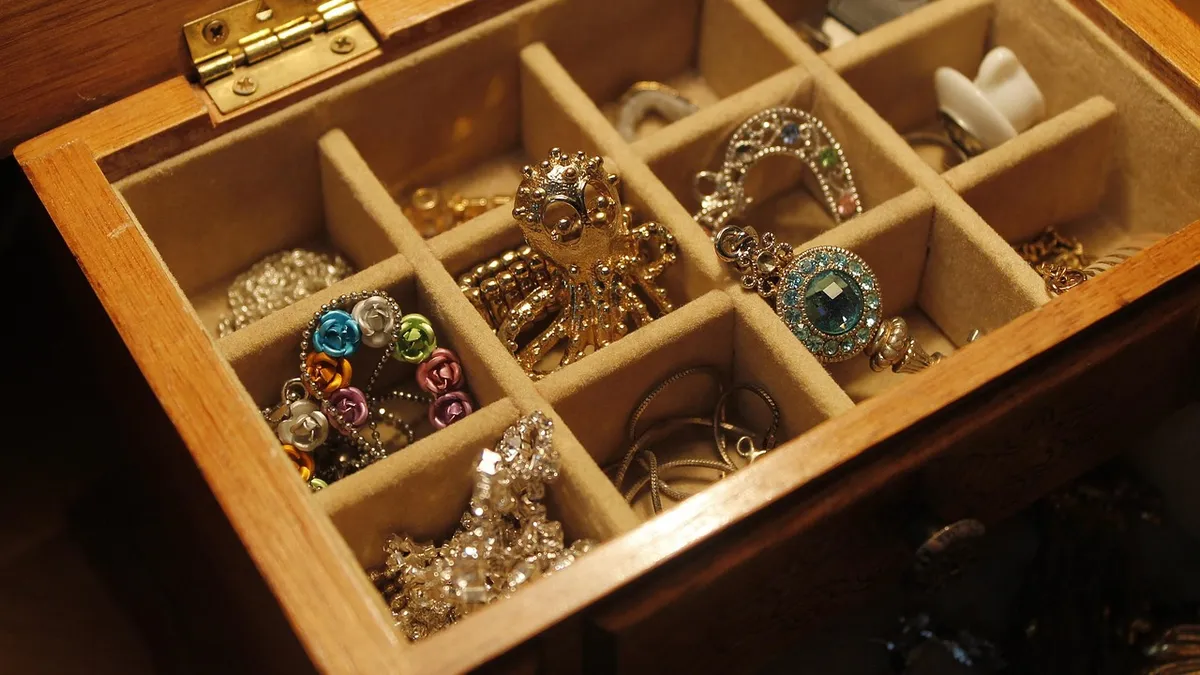
It’s tempting to sort jewelry by color or by how often you wear it, but compartment type exists for a mechanical reason, not just tidiness. Necklaces tangle when chains touch each other, rings and metal surfaces scratch when they rub together loose in a tray, and small earring backs get lost in open compartments. Sorting by jewelry type puts each piece in the compartment shape built to prevent its specific problem. The Gemological Institute of America’s own jewelry-organizing guidance backs this up: it recommends storing pieces in containers with multiple compartments specifically “to avoid tangling of necklaces or scratching of jewelry finishes or gemstones.”
The compartment-to-type matchup
These compartment names — hooks, ring slots, earring slots or holes, bracelet rods — are the real terms used on actual jewelry-armoire product listings, not invented categories. For example, a widely sold Songmics jewelry armoire sold through Target lists in its own product specifications 104 ring slots, 18 necklace hooks, three bracelet rods, 120 earring slots, and 54 earring holes — confirming these are compartment types manufacturers actually build, not categories invented for this guide. Here’s how to match each jewelry type to the compartment built for it, and what to do if your armoire doesn’t have that exact compartment.
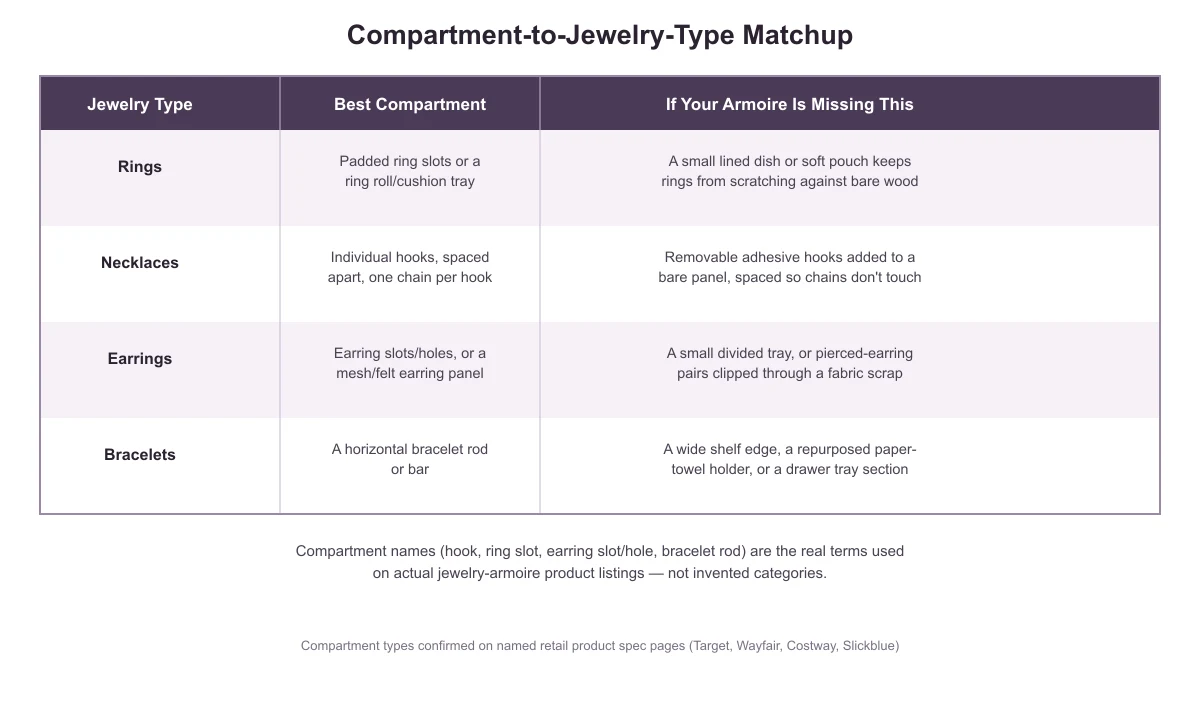
| Jewelry Type | Best Compartment | If Your Armoire Is Missing This |
|---|---|---|
| Rings | Padded ring slots or a ring roll/cushion tray | A small lined dish or soft pouch keeps rings from scratching against bare wood |
| Necklaces | Individual hooks, spaced apart, one chain per hook | Removable adhesive hooks added to a bare panel, spaced so chains don’t touch |
| Earrings | Earring slots/holes, or a mesh/felt earring panel | A small divided tray, or pierced-earring pairs clipped through a fabric scrap |
| Bracelets | A horizontal bracelet rod or bar | A wide shelf edge, a repurposed paper-towel holder, or a drawer tray section |
Rings: slots beat a loose pile
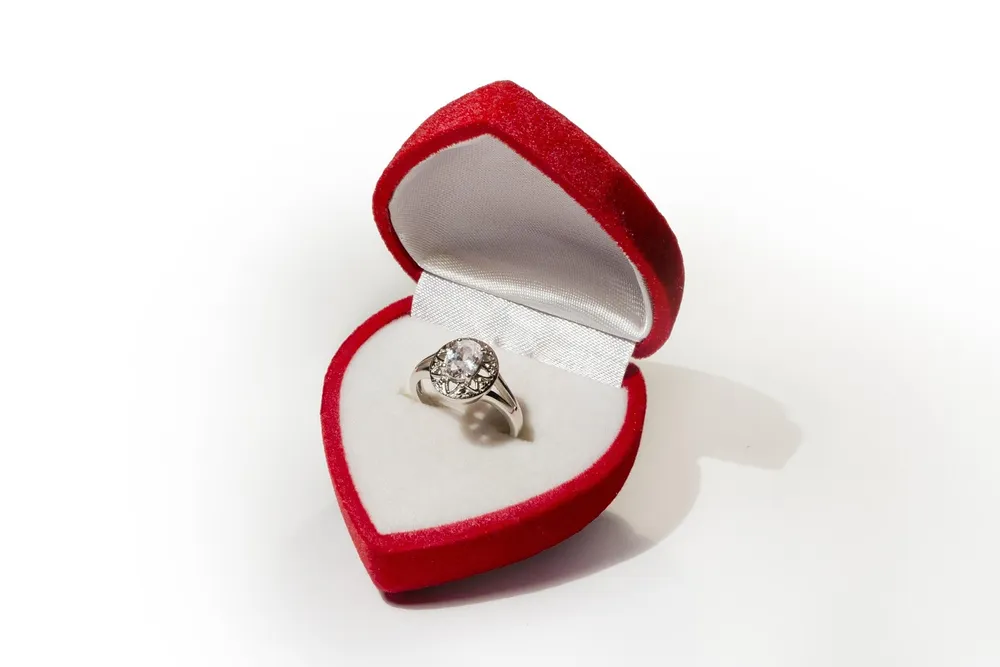
Loose rings rolling around in an open tray knock against each other and against the tray itself, which can scratch soft metals and loosen small stones over time. Padded ring slots hold each ring upright and separated. If your armoire doesn’t have dedicated ring slots, a small fabric-lined ring roll or a shallow dish with a soft liner is a reasonable substitute — the goal is simply to stop rings from touching bare wood, metal, or each other.
Necklaces: one chain, one hook
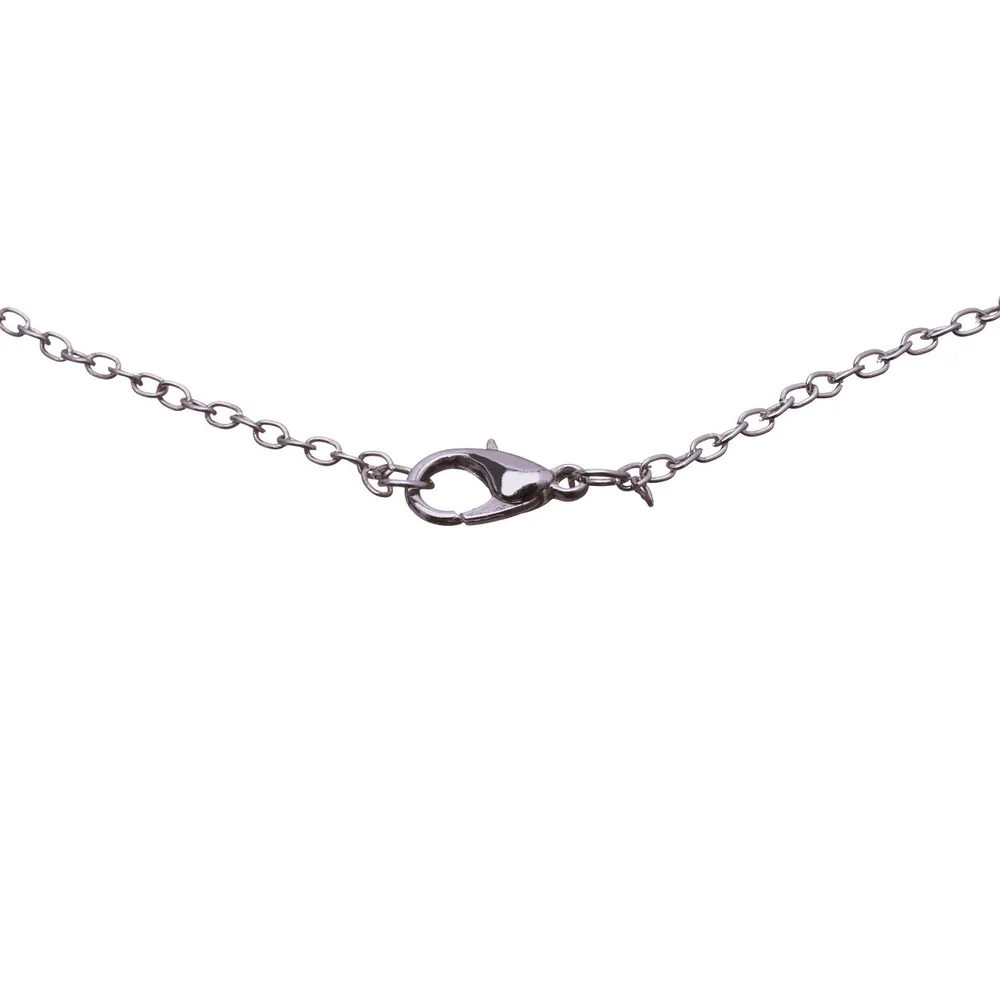
Chains tangle because they touch and twist around each other, not because of anything mysterious. The fix is entirely mechanical: hang one necklace per hook, and leave enough space between hooks that adjacent chains can’t swing into each other when the door opens and closes. If you have more necklaces than hooks, resist the urge to double up two chains on one hook — that’s exactly the crowding that causes tangling in the first place. For the complete hook-spacing method and a quick fix for an armoire that’s already a tangled mess, see How to Stop Necklaces From Tangling in a Jewelry Armoire.
Earrings: slots or a panel, not a dish
Earrings are small and easy to lose track of, especially the backs. Dedicated earring slots or holes, or a felt/mesh panel you push posts through, keep pairs together and visible at a glance. A shared open dish works for a very small number of pairs but quickly becomes a sorting problem once you own more than a handful — backs and small studs sink to the bottom and get overlooked.
Bracelets: give them a rod, not a drawer
A horizontal rod or bar lets bracelets hang separated and visible, which also makes it easy to see at a glance which ones you haven’t worn in a while. If your armoire doesn’t include a bracelet rod, a wide shelf edge or even a repurposed paper-towel holder mounted inside a drawer can serve the same function — the goal is keeping bracelets from tangling into a pile the way loose necklaces do.
Keeping it organized once it’s set up
The initial sort is the hard part; staying organized afterward is mostly about putting pieces back in their matched compartment right away instead of setting them on top of the armoire “for now.” A quick habit that helps: when you take off jewelry at the end of the day, return each piece to its compartment type immediately rather than batching it for later. Batched sorting is exactly how a tidy armoire slides back into a mixed pile within a few weeks.
It’s also worth a periodic look through each compartment, not to follow any fixed schedule, but to catch problems early — a ring slot that’s started holding two rings instead of one, hooks that are getting crowded again, or earring backs that have gone missing. Catching these early is easier than untangling or re-sorting a full compartment that’s been neglected for months.
What if you’re still deciding between a box and an armoire?
Compartment-based organizing works best once you have enough separate compartment types to actually use — which usually means you’ve already moved to armoire-scale storage. If you’re not sure whether your current jewelry box is still enough, see Jewelry Armoire vs. Jewelry Box: What’s the Real Difference for the warning signs that it’s time to upgrade, and the Jewelry Armoire Buying Guide for the complete buying decision checklist once you’re ready to choose one.
Frequently asked questions
What’s the single most common organizing mistake?
Mixing jewelry types in one open compartment instead of separating them. It’s the direct cause of tangled necklaces, scratched rings, and lost earring backs, and it’s the easiest thing to fix without buying anything new.
My armoire doesn’t have enough hooks for all my necklaces. What should I do?
Add removable adhesive hooks to any bare panel space inside the armoire, spaced the same way as the built-in hooks, rather than doubling chains up on the hooks you already have.
Should earrings be stored as pairs or by type?
Both, if possible — keep each pair together in one slot or hole, and group similar styles near each other so you can compare and choose quickly. Keeping pairs together matters more than grouping by style.
Can I use the same compartment for rings and earrings if space is tight?
It’s better not to. Rings and earring posts can scratch each other, and small earring backs are easy to lose in a shared compartment. A simple divider or a second small dish solves this without needing more armoire space.
Sources
- Songmics jewelry armoire product page, sold via Target — confirms real compartment types and counts (ring slots, necklace hooks, bracelet rods, earring slots/holes). Checked November 2026.
- Gemological Institute of America (GIA), “Five Tips to Organize Your Jewelry” — recommends multi-compartment organizers and individual hooks to prevent necklace tangling and jewelry scratching. Checked November 2026.
jewelryarmoireguide.com Editorial Team. Last updated: November 13, 2026.
Leave a Reply