Last updated: November 16, 2026
In short: most people should spend enough to get sturdy drawers, smooth hardware, and a finish that fits the room, but not extra for features they will not use. A jewelry armoire is one of those purchases where price tracks build quality, size, and storage layout more than looks alone, so the right budget depends on what you need it to hold and how long you want it to last.
Key takeaways
- Pay for structure first: a stable frame, good drawer slides, and hardware that does not wobble.
- Solid wood usually costs more than MDF, but the highest price does not always mean the best fit for your needs.
- Bigger armoires cost more because they use more material, more hardware, and more assembly time.
- Extra features, like a mirror or lock, can raise the price without making the piece more useful for everyone.
- A sensible budget is the one that matches your storage load, room size, and how hard the piece will be used.
What should you spend on a jewelry armoire?
You should spend enough to cover the quality level you need, not the fanciest version on the shelf. If you only need basic storage for a small jewelry collection, a lower price tier can make sense; if you want a tall piece with many drawers and a solid feel, the budget needs to go up.
Think of the price as a bundle of parts: frame, drawers, hardware, finish, and added features. A jewelry armoire with plain storage and simple hardware should cost less than one with more drawers, a larger footprint, and extra design details. That is why two pieces that look similar in photos can sit in very different price bands.
A good rule is to pay more when the armoire does one or more of these things well:
- holds a lot of items without feeling flimsy
- uses hardware that opens smoothly
- keeps drawers aligned
- fits your room without crowding it
Do not spend more just because the finish looks polished in a listing. A pretty surface can hide thin panels or weak drawer runners. The real question is whether the piece will still feel solid after months of opening and closing.
How do budget tiers usually compare?
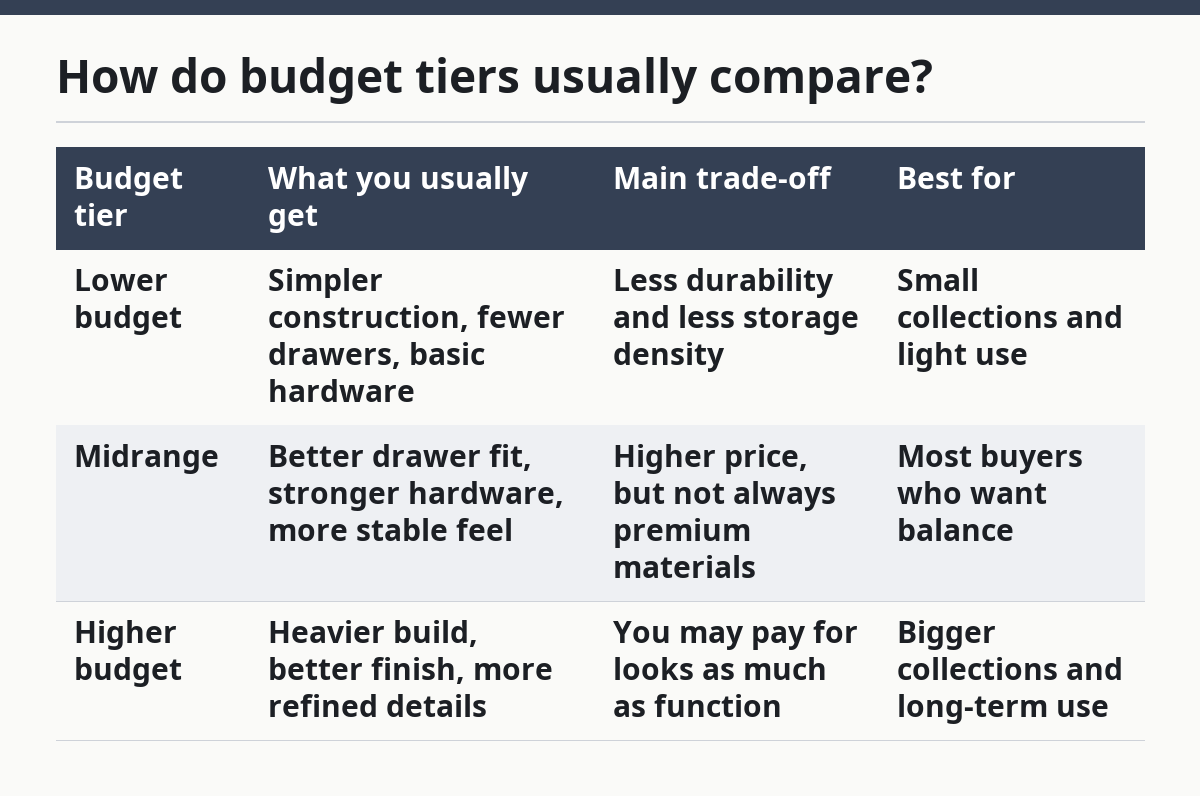
Budget tiers differ most in materials, drawer quality, and the amount of storage you get for the size. The table below gives a practical way to think about trade-offs before you shop.
| Budget tier | What you usually get | Main trade-off | Best for |
|---|---|---|---|
| Lower budget | Simpler construction, fewer drawers, basic hardware | Less durability and less storage density | Small collections and light use |
| Midrange | Better drawer fit, stronger hardware, more stable feel | Higher price, but not always premium materials | Most buyers who want balance |
| Higher budget | Heavier build, better finish, more refined details | You may pay for looks as much as function | Bigger collections and long-term use |
A lower budget can still work if you are clear about the limits. It is not the right choice if you expect daily use, heavy drawers, or a lot of items packed into one piece. In those cases, cheap hardware and thin panels tend to show their limits first.
Midrange is where many buyers land because it usually gives the best value. You are paying for a better build without drifting into decorative extras that do not change function much. Higher budget makes sense when the armoire is part storage, part furniture, and part room feature.
What drives the price most?
The biggest price drivers are material, size, hardware, and extras like a mirror. Those four things explain most of the gap between a simple piece and a more expensive one.
Material matters because it affects weight, stability, and finish quality. Solid wood usually costs more than MDF, while MDF can keep prices down but may feel less substantial. Hardware matters too: smoother hinges, drawer runners, and handles can raise cost, but they usually improve daily use more than decorative details do.
Size changes price in a straightforward way. A taller armoire with more drawers uses more material and more assembly time, so it usually costs more than a compact one. A larger footprint can also mean more weight, which affects shipping and handling.
Extras raise the price even when they do not change storage much. A mirror, extra compartments, or a lock can all add cost. If you will not use those features, they are just added expense.
How do material and size change what you pay?
Material and size change both the sticker price and the value you get from it. A larger armoire made from solid wood will usually cost more than a smaller MDF model, and that gap is not just about looks.
Here is the plain version. Solid wood often signals a higher-price piece because the material itself is pricier and can give the armoire a heavier feel. MDF can keep the price lower, which helps if you want storage without a big spend, but it may not deliver the same long-term feel or weight. If you want a piece that feels like furniture, not just a storage box, material matters a lot.
Size works the same way. A compact armoire costs less because it needs fewer materials and less hardware. A larger one with more drawers costs more, but it may be the better deal if you have enough items to fill it. Buying a big unit just because it seems like “more for the money” can backfire if it crowds the room or goes half empty.
Use this simple order of priority:
- Decide how much storage you actually need.
- Pick the size that fits the room first.
- Choose the material level that matches how long you want it to last.
- Only then compare finish and extras.
That order keeps you from paying for size you cannot use.
Which features are worth paying extra for?
You should pay extra only for features that improve daily use, not for features that only sound impressive on a product page. The best value usually comes from hardware, drawer layout, and overall stability.
A mirror can be useful if the armoire sits in a bedroom and replaces a separate standing mirror. If you already have a wall mirror or vanity mirror, paying extra for one built into the piece may not be worth it. The same goes for a lock: useful for some people, pointless for others.
Good hardware is worth real money because you touch it every day. Drawer slides, hinges, and handles affect how the armoire feels in use. If a piece has 8 or 10 drawers but the movement feels rough, the storage count does not make up for the annoyance.
Pay extra for these, if they matter to you:
- stronger hardware
- better drawer alignment
- a finish that matches the room
- size that fits your items without waste
Do not pay extra for a feature that duplicates something you already own. That is the easiest way to inflate the budget without improving the result.
How do you set a budget before shopping?
You set a budget by matching the armoire to your storage load, room size, and quality target. The goal is to avoid both extremes: buying too cheaply and replacing it early, or overspending on features you do not need.
Use this short process:
- Count what the armoire must hold, not what you hope it might hold later. A small daily collection and a larger inherited collection need different storage.
- Measure the spot where the piece will go. Height, width, and depth matter before style does.
- Decide which features are nonnegotiable. For some buyers, that is a mirror; for others, it is extra drawers or a heavier frame.
- Pick the lowest price tier that covers those needs without forcing a compromise on stability.
- Compare pieces at that tier by material and hardware, not by decoration alone.
If you are unsure where to land, start in the middle of the market and work up or down from there. That is often safer than picking the cheapest option first. The cheapest piece may be fine for very light use, but it is also the one most likely to disappoint if you want a furniture-like feel.
For a broader buying checklist, the jewelry armoire guide on this site is the right place to start before you compare models.
When is a cheaper jewelry armoire the right call?
A cheaper jewelry armoire is the right call when the collection is small, the use is light, and the piece does not need to last through years of daily opening and closing. If you are outfitting a guest room, a starter bedroom, or a temporary space, lower spend can be the sensible choice.
The trade-off is obvious: you usually give up weight, stability, and finer hardware. That does not mean every inexpensive piece is bad. It means the budget has to match the job. A light-use storage piece can be enough if you are not asking it to do the work of a premium furniture item.
A cheaper choice is a poor fit if you want a long-term centerpiece, a heavier feel, or a lot of storage in one unit. It is also a weak pick if you dislike wobble, rough drawer movement, or thin panels. In that case, spending a bit more usually buys a better daily experience.
FAQ
What affects the price of a jewelry armoire?
The price of a jewelry armoire is mainly affected by material, size, hardware, and added features. Solid wood, larger dimensions, smoother drawer parts, and extras like a mirror can all raise the cost. If the piece looks similar but one costs much more, the difference is often in build quality and finish rather than in storage count alone.
Is a more expensive jewelry armoire better?
A more expensive jewelry armoire is not always better, but it often has better construction or a more refined finish. The right question is whether the extra cost buys something you will notice every day, like sturdier drawers or a more stable frame. If the premium is mostly for decoration, the value may be weak.
How do I choose a jewelry armoire on a budget?
You choose a jewelry armoire on a budget by deciding what you cannot compromise on, then buying the least expensive piece that covers those needs. Start with size, storage, and hardware, then compare materials and finish. A budget piece works best when it is simple, stable, and not overloaded with features you do not need.
Drafted with AI; not yet reviewed by a person.
Leave a Reply